
Why IPC-2221 Is the Foundation for PCB Design
Aug 15, 2026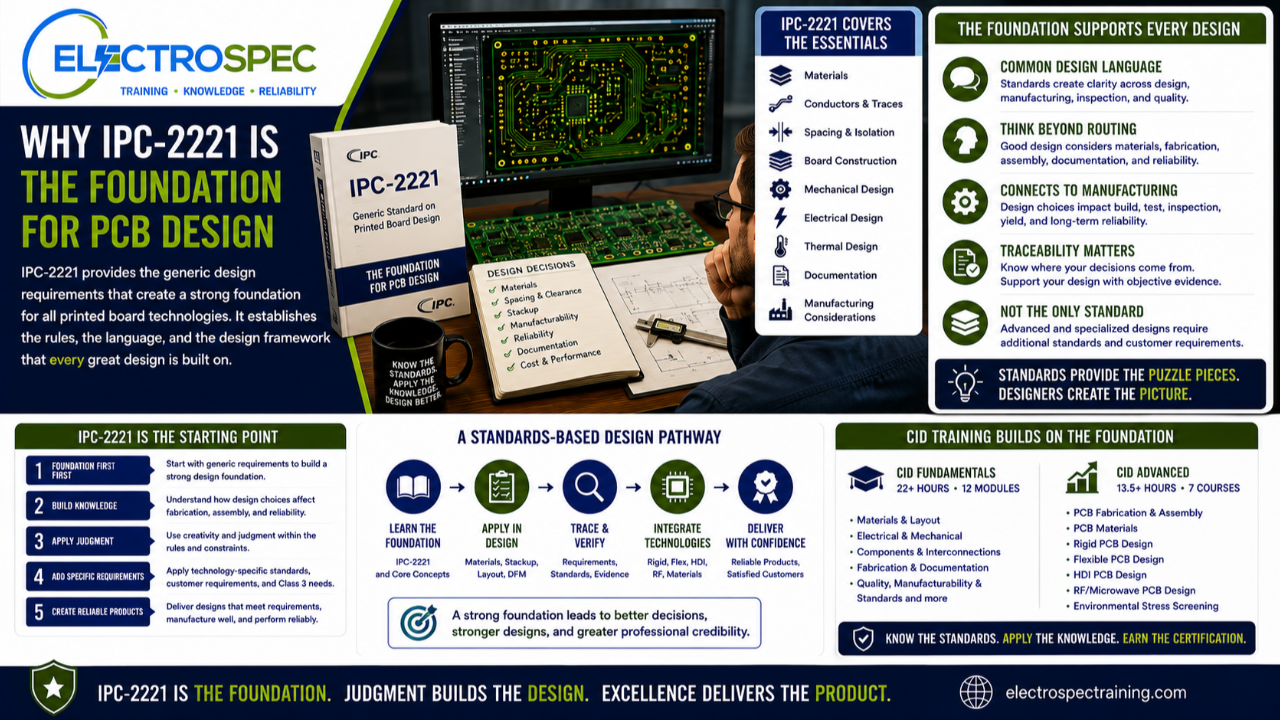
Every strong design discipline needs a foundation.
For PCB designers, one of the most important starting points is IPC-2221.
IPC-2221 provides generic design requirements for printed boards and printed board assemblies. It gives designers a common framework for thinking about materials, conductors, spacing, board construction, mechanical considerations, electrical considerations, thermal concerns, documentation, and manufacturing expectations.
That does not mean IPC-2221 answers every design question.
It does not.
But it gives designers a critical starting point.
That is why ElectroSpec’s CID Fundamentals course places so much emphasis on building a strong standards-based foundation before moving into advanced design topics.
A designer who does not understand the generic foundation will struggle when the design becomes rigid, flex, RF, HDI, high-reliability, aerospace, defense, medical, or harsh-environment specific.
Generic Does Not Mean Simple
The word “generic” can be misleading.
Some people hear “generic” and think basic, easy, or low importance.
That is not the right way to think about IPC-2221.
Generic means foundational.
It provides broad design requirements that support many printed board technologies. It helps establish the language, logic, and design considerations that more specific standards build upon.
A designer may later need to work with rigid boards, flex circuits, rigid-flex designs, RF and microwave boards, HDI structures, high-reliability applications, or customer-specific requirements.
But the designer still needs the foundation first.
That foundation is where IPC-2221 fits.
Standards Create a Common Design Language
PCB design requires communication across many groups.
Designers communicate with:
- electrical engineers
- mechanical engineers
- fabrication suppliers
- assembly suppliers
- process engineers
- inspectors
- quality engineers
- test engineers
- customers
- auditors
- program managers
Without a common language, requirements become unclear.
IPC-2221 helps provide that language.
It gives designers a way to think about design requirements in a structured manner. It supports communication about spacing, conductors, materials, board structure, documentation, reliability, and manufacturability.
That matters because PCB design is not only what happens in CAD.
PCB design is also what must be communicated to the people who build, inspect, test, and accept the product.
IPC-2221 Helps Designers Think Beyond Routing
Many new designers focus heavily on routing.
Routing is important, but PCB design is much broader than connecting nets.
A real design must consider:
- material selection
- board thickness
- copper thickness
- conductor width
- conductor spacing
- creepage and clearance
- via structures
- plated through-holes
- thermal management
- mechanical support
- component placement
- fabrication capability
- assembly process
- inspection access
- test access
- documentation
- reliability
- customer requirements
IPC-2221 helps designers think about the board as an engineered product, not just a routing exercise.
That is a major reason it is so important in CID training.
The Foundation Must Connect to Manufacturing
A design that cannot be manufactured reliably is not complete.
IPC-2221 helps designers understand that design decisions affect manufacturing outcomes.
For example:
A spacing decision may affect electrical performance, fabrication yield, inspection, and reliability.
A conductor width decision may affect current carrying capability, temperature rise, fabrication tolerance, and cost.
A material decision may affect soldering, thermal cycling, moisture behavior, impedance, and mechanical performance.
A documentation decision may affect supplier interpretation, inspection, acceptance, and objective evidence.
These are not isolated design details.
They are connected manufacturing realities.
That is why standards-based design training must connect design requirements to fabrication and assembly.
IPC-2221 Is a Starting Point, Not the Entire Map
IPC-2221 is foundational, but it is not the only standard a designer may need.
Once the design becomes more specific, additional standards and requirements may apply.
For example:
- rigid printed board design may require more specific rigid board design knowledge
- flex and rigid-flex design require specialized flex design understanding
- RF and microwave design introduce high-frequency material and geometry concerns
- high-reliability products may require additional Class 3 considerations
- aerospace, defense, space, medical, or harsh-environment products may involve customer, military, NASA, ESA, IEC, or program-specific requirements
- manufacturing and acceptance may connect to fabrication, assembly, soldering, inspection, and quality standards
This is why designers need standards literacy.
They need to understand not only one standard, but how standards connect.
IPC-2221 gives the foundation.
Good design judgment tells the designer when more specific requirements are needed.
CID Fundamentals Builds Around That Foundation
ElectroSpec’s CID Fundamentals course is designed to help students build a broad PCB design foundation.
The course includes 22+ hours of on-demand training across 12 structured modules covering topics such as:
- PCB materials
- layout principles
- mechanical considerations
- electrical considerations
- thermal management
- component technologies
- interconnections
- fabrication requirements
- documentation
- quality assurance
- manufacturability
- standards-based design thinking
That scope matters because IPC-2221 is not simply a document to memorize.
It is a design framework to understand and apply.
ElectroSpec CID helps students connect foundational design topics to real manufacturing and reliability concerns.
Designers Need Traceability
One of the most important skills a designer can develop is traceability.
When a designer makes a decision, the designer should understand where that decision comes from.
Is it based on IPC-2221?
Is it based on a more specific design standard?
Is it based on material capability?
Is it based on fabrication supplier limits?
Is it based on assembly process requirements?
Is it based on customer flow-downs?
Is it based on Class 3 expectations?
Is it based on qualification requirements?
Is it based on engineering judgment?
A designer who understands traceability can explain the design basis.
That is powerful.
It helps during design reviews, supplier discussions, customer audits, failure analysis, and product qualification.
A design decision without traceability may look like opinion.
A design decision with traceability becomes part of the engineering record.
Standards Do Not Eliminate Creativity
IPC-2221 gives requirements and structure.
It does not create the product.
The designer still has to solve the problem.
The designer still chooses the layout approach, stackup strategy, component placement, routing method, thermal solution, test access, documentation method, and reliability approach.
That is where creativity and judgment matter.
Standards provide the rules.
Designers create the solution.
The standard gives the puzzle pieces.
The designer creates the picture.
That is the proper relationship between standards and design.
Why This Matters for New Designers
New PCB designers often want immediate answers.
What trace width should I use?
What spacing should I apply?
What via size is acceptable?
What material should I select?
What documentation do I need?
Those are important questions.
But the stronger designer learns how to ask deeper questions:
- What requirement applies?
- What product class applies?
- What environment applies?
- What standard applies?
- What supplier capability applies?
- What customer requirement applies?
- What risk am I controlling?
- How will this be built?
- How will this be inspected?
- How will this be verified?
IPC-2221 helps build that deeper way of thinking.
That is why it belongs at the center of foundational PCB design training.
Why This Matters for Experienced Designers
Experienced designers also benefit from returning to the foundation.
As designs become more complex, it is easy to focus on specialized topics like HDI, RF, high-speed routing, flex, or harsh-environment reliability.
Those are important.
But advanced design still depends on foundational decisions.
Materials still matter.
Spacing still matters.
Documentation still matters.
Fabrication still matters.
Inspection still matters.
Reliability still matters.
IPC-2221 helps keep the designer grounded in the fundamental requirements that support the rest of the design.
The Foundation Supports Advanced Design
CID Advanced builds on the foundation created by CID.
ElectroSpec CID Advanced expands into:
- PCB Fabrication & Assembly
- PCB Materials
- Rigid PCB Design
- Flexible PCB Design
- HDI PCB Design
- RF/Microwave PCB Design
- Environmental Stress Screening
These advanced areas require stronger judgment because the tradeoffs become more complex.
A flex design has different risks than a rigid design.
An HDI design has different fabrication concerns than a conventional board.
An RF design has different material and geometry sensitivities.
A harsh-environment product has different qualification and reliability concerns.
But in each case, the designer still benefits from a strong generic foundation.
That is why IPC-2221 matters.
IPC-2221 Does Not Replace Customer Requirements
One important caution is that standards do not replace the customer requirement.
A customer drawing, contract, purchase order, program specification, or qualification plan may impose additional requirements.
Designers must understand the full requirement flow-down.
That may include:
- IPC design requirements
- customer drawings
- company design rules
- material specifications
- fabrication requirements
- assembly requirements
- inspection requirements
- Class 3 requirements
- NASA, ESA, military, or other program-specific requirements
- environmental qualification requirements
The designer must know what applies to the product.
IPC-2221 provides a foundation.
The complete design obligation comes from the full requirement set.
Independently Developed by ElectroSpec
ElectroSpec’s CID and CID Advanced courses are independently developed by ElectroSpec.
They are not IPC-authorized training and they are not official IPC curriculum.
ElectroSpec developed these courses to provide practical, standards-connected, manufacturing-aware design training for students preparing for CID and CID+ certification.
The focus is not only on what a standard says.
The focus is on how designers apply standards, requirements, materials, manufacturing knowledge, and judgment to real products.
Final Thought
IPC-2221 is important because it gives PCB designers a foundation.
It helps create a common language.
It supports standards traceability.
It helps designers think beyond routing.
It connects design choices to fabrication, assembly, documentation, reliability, and product acceptance.
But IPC-2221 is not the entire design.
The designer still has to apply judgment.
The designer still has to understand customer requirements.
The designer still has to know when more specific standards apply.
The designer still has to create the solution.
That is why CID training matters.
A strong foundation does not limit creativity.
It gives designers the structure they need to create better products.
Related ElectroSpec Training
ElectroSpec’s CID Fundamentals course provides 22+ hours of on-demand PCB design training across 12 structured modules.
ElectroSpec’s CID Advanced training expands into fabrication and assembly, materials, rigid PCB design, flexible PCB design, HDI PCB design, RF/microwave PCB design, and environmental stress screening.
Together, these courses help designers build a standards-connected foundation for CID and CID+ certification preparation.
Coming Next
Rigid, Flex, RF, and HDI: Why One PCB Design Standard Is Not Enough
In the next article, we will explain why IPC-2221 provides the foundation, but specific board technologies require deeper design knowledge and more specialized requirements.
IPC CID Certification — ElectroSpec
IPC CID+ Certification — ElectroSpec
IPC CID/CID+ Bundle — Complete PCB Design Certification — ElectroSpec