
Design Standards Do Not Replace Design Judgment
Aug 14, 2026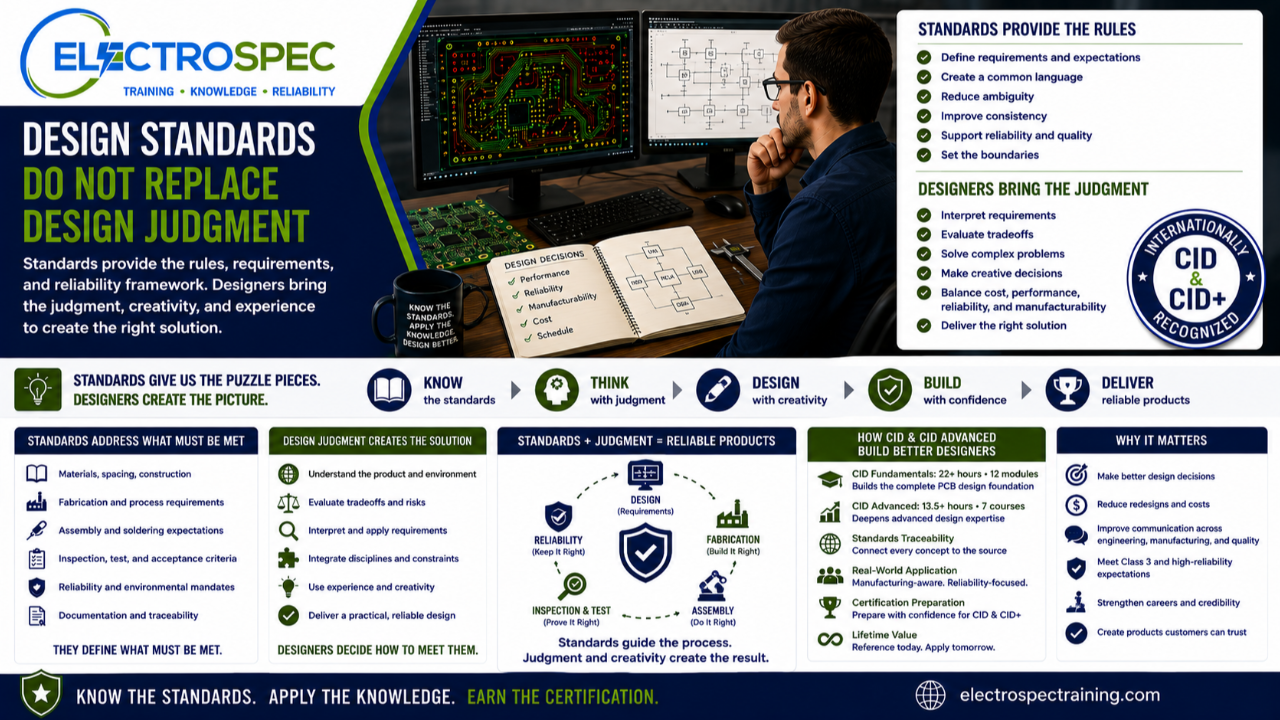
Standards are essential in electronics design and manufacturing.
They help define requirements, expectations, materials, processes, acceptance criteria, documentation needs, and reliability considerations.
They give engineers and designers a common language.
They help customers, suppliers, manufacturers, inspectors, and quality teams understand what the product must meet.
But standards do not create the design.
Designers do.
That distinction matters.
A standard can tell you the rules of the game. It can define limits, constraints, requirements, and expectations. But the designer still has to make decisions, solve problems, balance tradeoffs, and create the final product.
That is why strong PCB design training must teach more than standards awareness.
It must help designers understand how to apply standards with judgment.
Standards Provide the Rules
In PCB design, standards provide structure.
They may help address topics such as:
- materials
- conductor sizing
- spacing
- board construction
- documentation
- fabrication requirements
- assembly considerations
- soldering expectations
- inspection criteria
- reliability concerns
- environmental requirements
- product class expectations
Without standards, every organization would define requirements differently.
That would make communication harder, supplier expectations unclear, and product acceptance more subjective.
Standards help reduce ambiguity.
They help create consistency.
They help define what matters.
But standards are not design automation.
They do not remove the need for engineering judgment.
A Rule Still Requires Interpretation
Even when a requirement is clearly stated, the designer must still understand how it applies.
The designer must ask:
- What product class applies?
- What environment will the product see?
- What customer requirements are flowed down?
- What fabrication capability is available?
- What materials are appropriate?
- What assembly process will be used?
- What inspection method will verify the requirement?
- What reliability risks exist?
- What tradeoffs are acceptable?
- What must be documented?
The same general design principle may lead to different design choices depending on the product.
A low-risk commercial product may not require the same design approach as a Class 3 aerospace, defense, medical, or harsh-environment product.
The standard may provide the requirement framework.
The designer still has to apply it correctly.
Standards Are the Puzzle Pieces
A useful way to think about standards is this:
Standards provide the puzzle pieces. The designer creates the picture.
The pieces must fit together.
Spacing, materials, stackup, routing, solderability, fabrication limits, inspection access, testability, and reliability all have rules and constraints.
But the final product is not created by the standard.
The designer decides how the pieces come together.
That is the creative part of engineering.
A talented designer works within the rules while still creating a practical, manufacturable, reliable product.
That is not just compliance.
That is design.
Creativity Still Matters
Some people think standards limit creativity.
In reality, standards often make responsible creativity possible.
Designers still make creative decisions about:
- component placement
- routing strategy
- stackup structure
- interconnection approach
- thermal paths
- mechanical support
- material selection
- board shape
- connector strategy
- inspection access
- test strategy
- reliability approach
- manufacturing flow
The standard may define boundaries.
But inside those boundaries, the designer still has room to solve the problem.
That is similar to Boolean logic.
The rules are fixed.
The logic must be valid.
But the final circuit, architecture, and product solution still come from the engineer’s creativity and judgment.
CID Builds the Foundation
ElectroSpec’s CID Fundamentals course is designed to help students build that foundation.
CID is not just about memorizing design facts.
It is about understanding how PCB design requirements connect across the product lifecycle.
ElectroSpec CID includes 22+ hours of on-demand PCB fundamentals training across 12 structured modules covering materials, layout principles, mechanical and electrical considerations, thermal management, component technologies, interconnections, fabrication requirements, documentation, and quality assurance.
That matters because designers need to understand how design choices affect real products.
A designer who understands standards, materials, fabrication, documentation, and manufacturability can make better decisions before problems reach production.
CID Advanced Builds the Next Layer
Advanced design requires more than basic familiarity with PCB layout.
ElectroSpec CID Advanced expands into specialized design areas, including:
- PCB Fabrication & Assembly
- PCB Materials
- Rigid PCB Design
- Flexible PCB Design
- HDI PCB Design
- RF/Microwave PCB Design
- Environmental Stress Screening
These areas help designers understand advanced design tradeoffs.
Rigid board design has different concerns than flex design.
HDI introduces different fabrication and reliability risks.
RF and microwave design depend heavily on materials, stackup, geometry, and fabrication control.
Environmental stress screening connects design decisions to shock, vibration, thermal cycling, humidity, and real-world reliability.
Advanced designers must understand how the pieces interact.
Standards Traceability Supports Better Decisions
One of the most important skills a designer can develop is traceability.
When a designer makes a decision, they should understand where that decision comes from.
Is it based on a standard?
Is it based on supplier capability?
Is it based on customer requirements?
Is it based on Class 3 expectations?
Is it based on NASA, ESA, military, medical, or harsh-environment requirements?
Is it based on environmental qualification?
Is it based on engineering judgment?
Traceability helps designers explain and defend their decisions.
It also helps quality teams, manufacturers, inspectors, auditors, and customers understand the design basis.
A design decision without traceability can become an opinion.
A design decision with traceability becomes part of the engineering record.
Standards Do Not Eliminate Tradeoffs
PCB design is full of tradeoffs.
A designer may need to balance:
- cost and reliability
- density and manufacturability
- performance and material availability
- routing efficiency and inspection access
- miniaturization and reworkability
- thermal performance and mechanical constraints
- flexibility and durability
- speed and signal integrity
- fabrication capability and design ambition
- customer requirements and production reality
Standards help define limits, but they do not always choose the best answer.
The designer must evaluate the tradeoff.
That is where experience, judgment, and training matter.
The Best Designers Know the Rules and the Reason
A weak designer may only ask, “What does the rule say?”
A stronger designer asks, “Why does the rule exist, what risk is it controlling, and how does it apply to this product?”
That difference matters.
When designers understand the reason behind a requirement, they are better prepared to:
- avoid design mistakes
- communicate with suppliers
- work with manufacturing
- support inspection and test
- reduce redesign
- improve reliability
- support customer confidence
- prepare for audits
- make better tradeoffs
Knowing the rule is important.
Understanding the reason is what makes the knowledge useful.
Standards Support Reliability
Reliability does not happen by accident.
A reliable design depends on good decisions about materials, fabrication, assembly, soldering, inspection, test, environment, and process control.
Standards help define many of those expectations.
But the designer must still apply them.
A product does not become reliable simply because a standard is referenced on a drawing.
The design must support the requirement.
The process must support the requirement.
The inspection and test strategy must verify the requirement.
The documentation must communicate the requirement.
That is why design standards and design judgment must work together.
Independently Developed by ElectroSpec
ElectroSpec’s CID and CID Advanced courses are independently developed by ElectroSpec.
They are not IPC-authorized training and they are not official IPC curriculum.
ElectroSpec developed these courses to provide practical, standards-connected, manufacturing-aware design training for students pursuing CID and CID+ certification preparation.
The purpose is not only to teach what standards say.
The purpose is to help designers understand how standards, materials, fabrication, manufacturing, inspection, qualification, and reliability connect in real products.
Final Thought
Design standards are essential.
They provide rules, requirements, structure, and reliability expectations.
But standards do not replace design judgment.
They do not replace creativity.
They do not replace experience.
They do not replace the designer’s responsibility to understand the product, the environment, the manufacturing process, and the customer requirement.
Standards provide the puzzle pieces.
The designer creates the picture.
That is why CID and CID Advanced matter.
They help designers understand the rules, trace the requirements, apply the knowledge, and create better products.
Related ElectroSpec Training
ElectroSpec’s CID Fundamentals course provides 22+ hours of on-demand PCB design training across 12 structured modules.
ElectroSpec’s CID Advanced training includes PCB Fabrication & Assembly, PCB Materials, Rigid PCB Design, Flexible PCB Design, HDI PCB Design, RF/Microwave PCB Design, and Environmental Stress Screening.
Together, these courses help designers build a standards-connected foundation for CID and CID+ certification preparation.
Coming Next
Why IPC-2221 Is the Foundation for PCB Design
In the next article, we will discuss why generic PCB design requirements matter and why foundational standards help designers build a stronger framework before moving into rigid, flex, RF, HDI, materials, and high-reliability design.
IPC CID Certification — ElectroSpec
IPC CID+ Certification — ElectroSpec
IPC CID/CID+ Bundle — Complete PCB Design Certification — ElectroSpec