
PCB Design for Manufacturability: Standalone Topic or Standards-Based Design Skill?
Aug 05, 2026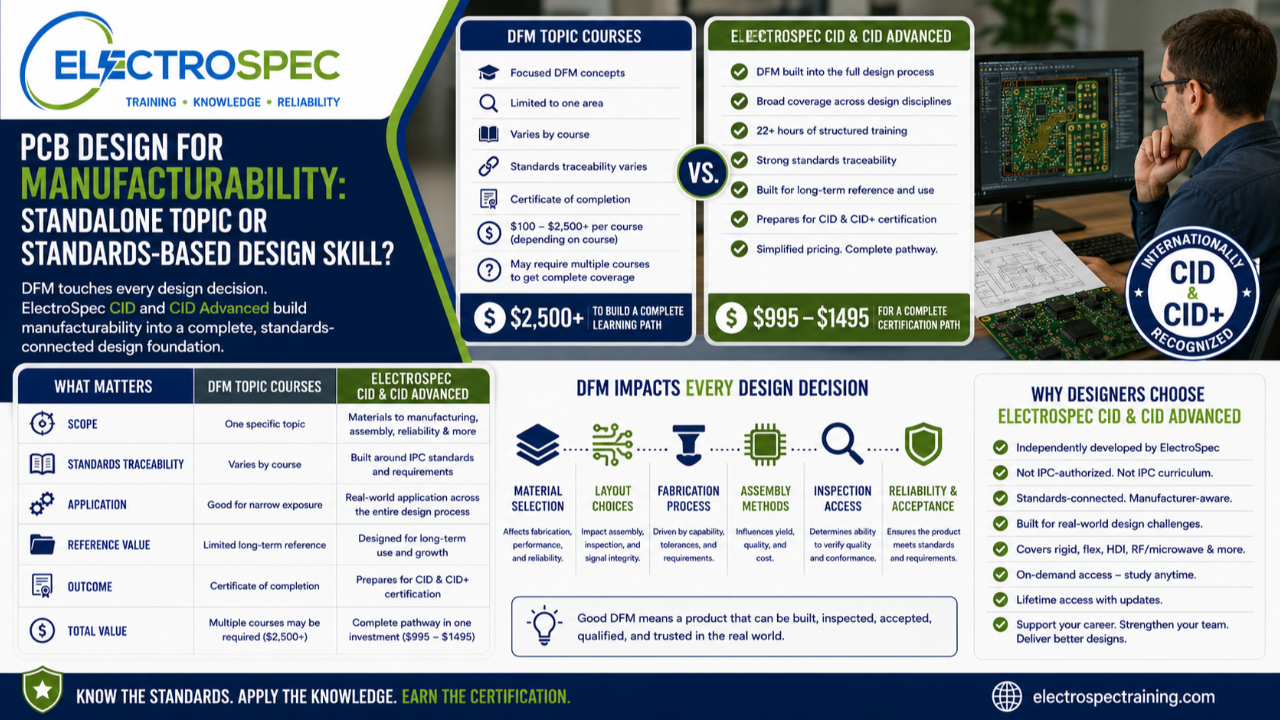
Design for manufacturability is one of the most important topics in PCB design.
A designer can create a circuit that works electrically, but still create a product that is difficult to fabricate, difficult to assemble, difficult to inspect, difficult to test, or difficult to qualify.
That is why manufacturability training matters.
But there is an important question buyers should ask when comparing PCB design courses:
Is design for manufacturability being taught as a standalone topic, or is it being connected back to the standards, materials, fabrication processes, assembly realities, inspection requirements, and certification pathway that designers need?
That distinction matters.
DFM is not just a course title.
DFM is a design discipline.
Manufacturability Is Not One Isolated Topic
PCB design for manufacturability is often presented as a specific course category.
That can be useful.
A focused DFM course may help a student understand common issues such as supplier questions, fabrication delays, layout corrections, spacing problems, process limitations, and design changes that could have been avoided earlier.
But real manufacturability is much broader than one topic.
Manufacturability touches nearly every design decision, including:
- laminate selection
- copper weight
- board thickness
- stackup
- conductor width and spacing
- hole size and tolerance
- annular ring
- via structures
- pad geometry
- solder mask
- surface finish
- component placement
- thermal relief
- panelization
- documentation
- assembly process selection
- inspection access
- rework access
- test access
- cleanliness
- coating
- reliability
That is why DFM should not be treated as a disconnected subject.
It should be part of the designer’s full technical foundation.
The IPC Topic Course Approach
Based on the catalog examples reviewed, IPC offers manufacturability-focused PCB design training such as introductory design for manufacturability and PCB design for manufacturability courses.
Those courses may be useful for designers who need a focused introduction to DFM concepts.
The advantage of a topic course is simplicity.
A student can select one subject, complete that course, and gain exposure to a specific area.
But the limitation is also clear.
A manufacturability topic course may not give the student the complete design framework needed to connect manufacturability back to standards, certification preparation, material requirements, fabrication requirements, assembly requirements, acceptance criteria, and reliability.
In real design work, manufacturability is not separated from those areas.
It is built from them.
ElectroSpec’s Approach: DFM Built Into the Design Foundation
ElectroSpec’s CID course is a 22+ hour on-demand PCB Fundamentals Course with 12 structured modules covering materials, layout principles, mechanical and electrical considerations, thermal management, component technologies, interconnections, fabrication requirements, documentation, and quality assurance.
Manufacturability is not treated as a side topic.
It is built into the way the course approaches design.
That is important because the designer needs to understand how requirements connect.
A material decision affects fabrication.
A layout decision affects assembly.
A pad decision affects solder joint formation.
A spacing decision affects inspection and reliability.
A documentation decision affects supplier interpretation.
A thermal decision affects product performance and field life.
Good DFM is not just about avoiding fabrication questions.
It is about designing a product that can be built, inspected, accepted, and relied upon.
ElectroSpec CID Advanced Extends DFM Into Advanced Design Areas
ElectroSpec’s CID Advanced training expands the manufacturability discussion into more specialized design areas.
The advanced track includes:
- PCB Fabrication & Assembly
- PCB Materials
- Rigid PCB Design
- Flexible PCB Design
- HDI PCB Design
- RF/Microwave PCB Design
- Environmental Stress Screening
Each of these areas has manufacturability implications.
Rigid board design has fabrication and assembly constraints.
Flex and rigid-flex design introduce bend reliability, material stackup, coverlay, adhesive, and mechanical stress concerns.
HDI design introduces microvias, fine features, sequential lamination, yield, and reliability risks.
RF and microwave design depends on material control, stackup, copper, impedance, geometry, and fabrication tolerance.
Environmental stress screening connects design choices to real-world reliability, qualification, and harsh environment performance.
That is why advanced DFM cannot be separated from materials, technology type, and reliability expectations.
Standards Traceability Matters
One of ElectroSpec’s strongest advantages is standards traceability.
Designers should not only learn that something is a good practice.
They should understand where the requirement or design concern comes from.
For example:
- Is the concern tied to IPC-2221 generic design principles?
- Is it tied to rigid board design requirements?
- Is it tied to flex or rigid-flex design requirements?
- Is it tied to RF or high-frequency design considerations?
- Is it tied to material specifications?
- Is it tied to bare board acceptability?
- Is it tied to assembly acceptability?
- Is it tied to soldering process requirements?
- Is it tied to Class 3 reliability expectations?
- Is it tied to customer flow-downs?
- Is it tied to environmental or qualification requirements?
A short DFM course may give useful advice.
But a designer needs traceability.
The designer needs to know what is required, what is recommended, what is supplier capability, what is customer flow-down, and what is engineering judgment.
That is the difference between learning tips and building a professional design framework.
Courses Come and Go, But DFM Requirements Remain
Training catalogs change over time.
Course names change.
Topics are added, removed, repackaged, or renamed.
That is normal in the training marketplace.
But the designer still needs a durable reference framework.
DFM knowledge must survive beyond one course title.
Designers need to return to the underlying standards, materials, fabrication requirements, assembly realities, documentation expectations, and quality requirements long after the course is complete.
ElectroSpec’s CID and CID Advanced training is designed to give students that type of reference framework.
The purpose is not only to complete a course.
The purpose is to build design knowledge that can be applied repeatedly in real projects.
Certificate of Completion vs. Certification Preparation
Many topic courses lead to a certificate of completion.
That can be useful.
It shows that a student completed the course.
But a certificate of completion is not the same as preparing for an internationally recognized PCB design certification.
ElectroSpec CID and CID Advanced are built to support CID and CID+ certification preparation.
That matters because the training outcome is different.
A DFM topic course may help fill a knowledge gap.
ElectroSpec’s design training helps build a broader certification pathway.
For designers who want professional credibility, career growth, and stronger design capability, that difference matters.
Price and Value
Price should be compared to scope and outcome.
Based on the catalog examples reviewed, IPC manufacturability-focused courses may include lower-cost introductory options and higher-cost topic courses. That may be a good fit for someone who only needs brief exposure to DFM.
But a designer who needs a broader pathway must consider the total cost of purchasing multiple individual topic courses to cover materials, fabrication, assembly, flex, HDI, RF, signal integrity, military and aerospace applications, and reliability.
ElectroSpec’s simplified comparison is different.
ElectroSpec CID and CID Advanced are commonly positioned in the $995 to $1,495 range, depending on the specific offering.
Some individual or combined topic pathways can reach $2,500+ when multiple courses are needed to build a complete learning path.
The better question is not only, “What does one course cost?”
The better question is:
What does it cost to build a complete standards-based design foundation that supports CID or CID+ certification preparation?
Comparison Summary
| Question | DFM Topic Course | ElectroSpec CID and CID Advanced |
|---|---|---|
| Main purpose | Teach manufacturability as a focused topic | Build manufacturability into a broader design pathway |
| Scope | Course dependent | Materials, layout, fabrication, assembly, documentation, quality, reliability |
| Standards traceability | Varies by course | Built around standards and requirements |
| Reference value | May be limited to course topic | Designed for long-term use and application |
| Advanced coverage | May require additional courses | Advanced track includes fabrication, materials, rigid, flex, HDI, RF, and ESS |
| Outcome | Often certificate of completion | Supports CID and CID+ certification preparation |
| Best fit | Narrow DFM exposure | Designers seeking a complete standards-based certification path |
DFM Is About More Than Getting Through Fabrication
A common mistake is thinking DFM only means avoiding board shop questions.
That is too narrow.
Good DFM helps answer:
- Can the board be fabricated reliably?
- Can it be assembled consistently?
- Can solder joints be formed properly?
- Can the product be inspected?
- Can the product be tested?
- Can the product be reworked if allowed?
- Can the product meet acceptance criteria?
- Can the product survive the intended environment?
- Can objective evidence prove conformance?
That is why manufacturability belongs inside a broader design education pathway.
Independently Developed by ElectroSpec
ElectroSpec’s CID and CID Advanced courses are independently developed by ElectroSpec.
They are not IPC-authorized training and they are not official IPC curriculum.
ElectroSpec built these courses to provide practical, standards-connected, manufacturing-aware training for designers pursuing CID and CID+ certification preparation.
The goal is to help designers understand the rules, apply the standards, and make better design decisions.
Final Thought
Design for manufacturability is too important to be treated as a disconnected topic.
It belongs inside the full design process.
A designer must understand materials, fabrication, assembly, inspection, documentation, quality, reliability, and standards traceability.
A topic course may teach selected DFM concepts.
ElectroSpec CID and CID Advanced help build a broader design framework that connects manufacturability to standards, real-world application, and certification preparation.
DFM is not just about making the board easier to build.
It is about designing a product that can be manufactured, inspected, accepted, qualified, and trusted.
Related ElectroSpec Training
ElectroSpec’s CID Fundamentals course provides 22+ hours of on-demand PCB design training across 12 structured modules.
ElectroSpec’s CID Advanced training expands into fabrication and assembly, materials, rigid PCB design, flexible PCB design, HDI PCB design, RF/microwave PCB design, and environmental stress screening.
Together, they provide a practical, standards-connected pathway for designers preparing for CID and CID+ certification.
Coming Next
PCB Fabrication and Materials: Why Designers Need Traceability Back to Standards
In the next article, we will compare fabrication and materials-focused PCB design courses with ElectroSpec’s CID and CID Advanced coverage, showing why material and fabrication decisions must connect back to standards, requirements, manufacturing capability, and reliability.
IPC CID Certification — ElectroSpec
IPC CID+ Certification — ElectroSpec
IPC CID/CID+ Bundle — Complete PCB Design Certification — ElectroSpec