
Why Designers Must Design for the Manufacturing Process
Jul 24, 2026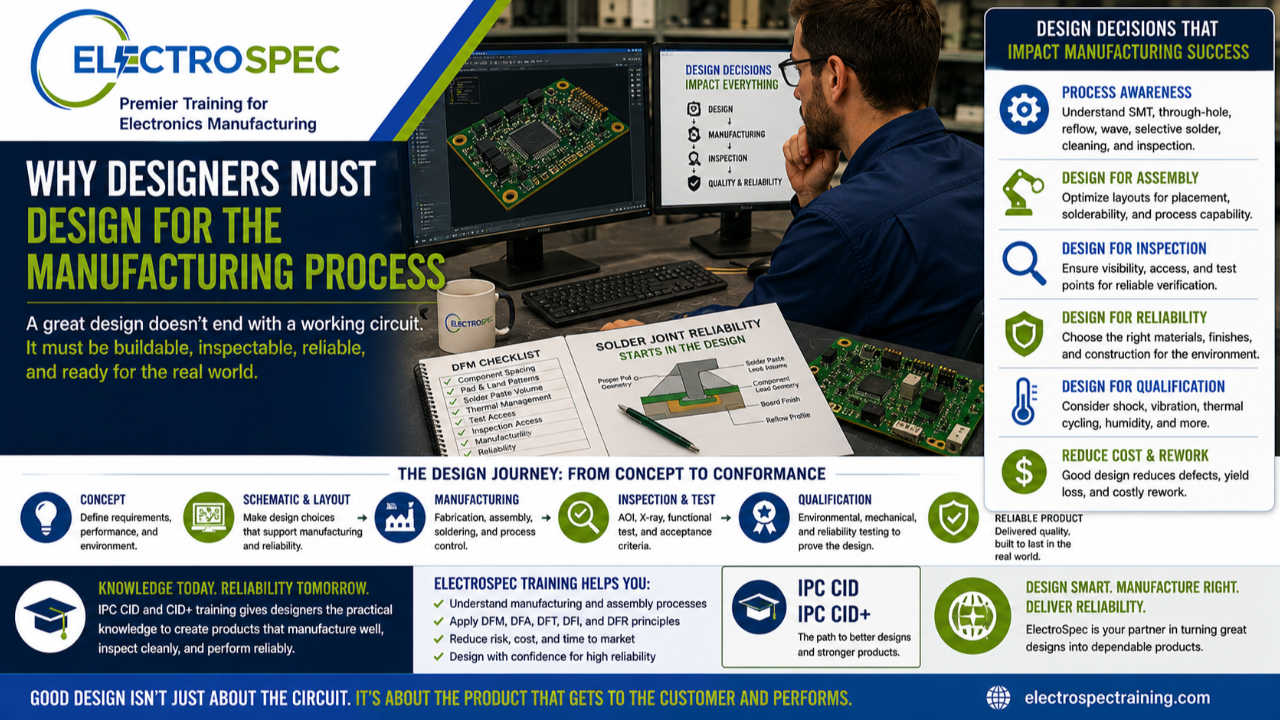
A printed circuit board design can be electrically correct and still be difficult, expensive, or unreliable to manufacture.
That is one of the most important lessons in electronics manufacturing.
The designer’s job is not only to create a circuit that works. The designer must also create a product that can be fabricated, assembled, soldered, inspected, tested, qualified, and delivered reliably.
In other words, a good design is not only functional.
A good design is manufacturable.
Design Decisions Flow Downstream
Every design decision affects someone else.
Component selection affects assembly.
Pad geometry affects solder joint formation.
Board finish affects solderability.
Material selection affects thermal performance and reliability.
Component spacing affects inspection and rework.
Connector placement affects assembly and serviceability.
Test access affects verification.
The designer may never operate the SMT line, wave solder machine, selective solder system, or inspection station, but the designer’s decisions influence every one of those operations.
By the time a product reaches the production floor, many manufacturing outcomes have already been shaped by the design.
Manufacturing Cannot Always Fix Poor Design
Process engineers and manufacturing engineers can do a lot.
They can optimize solder paste printing.
They can develop reflow profiles.
They can select tooling.
They can adjust wave solder parameters.
They can create work instructions.
They can train operators.
They can improve inspection methods.
But they cannot always overcome poor design choices.
If a component land pattern is wrong, the solder joint may be difficult to form consistently.
If components are too close together, inspection and rework may become difficult.
If thermal mass is unbalanced, reflow results may become inconsistent.
If test access is not provided, verification may require expensive workarounds.
If the board stackup, materials, or layout do not support the environment, qualification may become difficult or impossible.
Good manufacturing begins with good design.
Designers Must Understand the Process
Designers do not need to become soldering operators.
They do not need to run every machine on the production floor.
But they do need to understand how their design will move through manufacturing.
That includes understanding processes such as:
- PCB fabrication
- solder paste printing
- SMT placement
- mass reflow
- through-hole assembly
- wave soldering
- selective soldering
- cleaning
- conformal coating
- inspection
- test
- rework and repair
Each process has limitations.
Each process has design needs.
Each process can be made easier or harder by the design.
SMT Design Is Different from Hand Soldering
Modern electronics manufacturing often relies on automated or semi-automated processes.
Surface mount technology depends heavily on the design of the land pattern, solder paste volume, stencil aperture, component geometry, placement accuracy, and thermal profile.
In SMT manufacturing, the solder joint is not created by a person manually applying solder to each termination.
It is created by a system.
That system includes:
- PCB pad design
- component termination design
- solder paste selection
- stencil design
- placement accuracy
- flux chemistry
- reflow profile
- board finish
- component finish
- thermal balance
- process control
This is why design and process engineering must work together.
A designer who understands SMT manufacturing is better equipped to create layouts that support stable solder joint formation.
Through-Hole Design Also Depends on the Process
Through-hole technology has its own design concerns.
A through-hole solder joint may be produced by wave soldering, selective soldering, drag soldering, robotic soldering, or manual soldering.
Each method has different requirements.
Designers must consider:
- hole size
- lead diameter
- annular ring
- lead protrusion
- thermal relief
- component spacing
- solder access
- board thickness
- copper distribution
- keep-out areas
- connector orientation
- inspection visibility
A design that works well for manual soldering may not work well for wave soldering.
A design that works for selective soldering may require nozzle access, spacing, and thermal considerations.
The manufacturing process matters.
Acceptance Criteria Begin Upstream
Product acceptance is often associated with inspection.
For electronic assemblies, IPC-A-610 is commonly used to evaluate finished workmanship.
But the ability to meet IPC-A-610 acceptance criteria often begins at design.
Designers influence whether the finished product can meet requirements for solder joints, component mounting, spacing, cleanliness, marking, hardware installation, and inspection access.
Inspectors verify the final product.
Operators build according to work instructions.
Process engineers control the manufacturing process.
But designers help determine whether the product can realistically meet the final acceptance criteria in the first place.
Qualification Also Begins in Design
Some products must survive demanding environments.
That may include:
- vibration
- shock
- thermal cycling
- humidity
- contamination
- corrosion
- altitude
- mechanical stress
- long service life
- mission-critical use
Qualification is not something that can simply be added at the end.
The design must support the environment.
That means selecting appropriate materials, components, board construction, mechanical support, interconnects, coatings, solder joint geometries, and manufacturing processes.
A product that is not designed for its environment may fail qualification even if it was built exactly as documented.
The Designer’s Responsibility
A designer must balance many competing requirements:
- electrical performance
- cost
- schedule
- manufacturability
- assembly process
- inspection access
- testability
- reliability
- qualification
- customer requirements
- industry standards
That is not easy.
But it is essential.
Electronics manufacturing problems often appear on the production floor, but many of them begin in design.
The earlier those risks are understood, the easier they are to prevent.
A Better Design Mindset
Instead of asking only:
“Does the circuit work?”
Designers should also ask:
- Can this board be fabricated reliably?
- Can this assembly be built using the intended manufacturing process?
- Can the solder joints form consistently?
- Can the product be inspected?
- Can the product be tested?
- Can the product be reworked if necessary?
- Can the product meet acceptance criteria?
- Can the product survive qualification?
- Can the user depend on it?
Those questions move design from electrical function to manufacturing excellence.
Final Thought
Designers do not just design circuits.
They design the foundation for fabrication, assembly, inspection, qualification, and long-term reliability.
A good design is not only electrically correct.
It is manufacturable, inspectable, acceptable, and qualifiable.
When designers understand the manufacturing process, they make better decisions early—before those decisions become costly production problems.
Related ElectroSpec Training
ElectroSpec’s IPC CID and CID+ training programs help PCB designers and product engineers understand design principles, manufacturability, fabrication, assembly, reliability, and the practical consequences of design decisions.
For designers working in high-reliability electronics, understanding how design affects manufacturing is not optional. It is part of building products that can meet customer expectations and perform in the field.
Coming Next
Why Solder Joint Reliability Starts with Design, Not the Soldering Operator
In the next article, we will explain how pad geometry, component lead geometry, solder paste, stencil design, board finish, component finish, and thermal profile influence solder joint reliability before an operator ever touches the product.
Related Reading
- SMT Assembly Is Not Hand Soldering: Why Training Must Match the Process
- Through-Hole Design: Wave Solder, Selective Solder, and Process Reality
- Why Designers, Process Engineers, and Inspectors Must Talk Before Production