
Why Designers, Process Engineers, and Inspectors Must Talk Before Production
Aug 01, 2026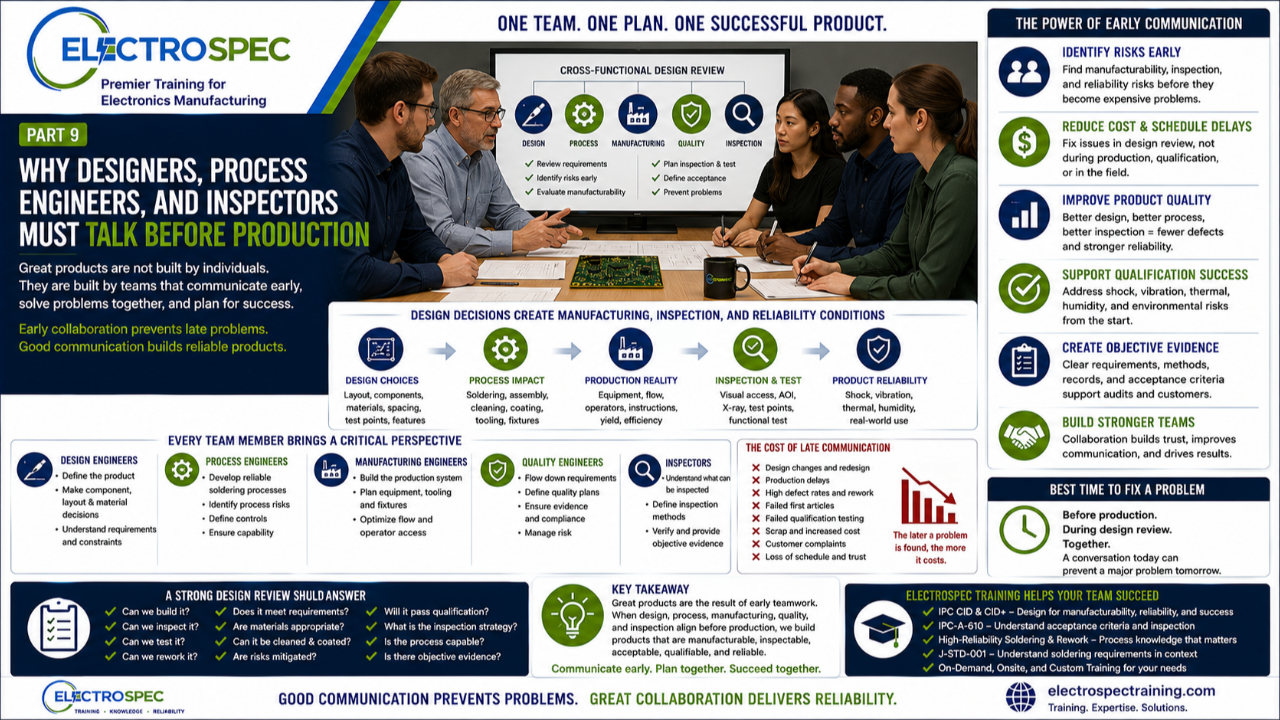
In the previous article, we discussed why qualification success begins in design.
A product does not pass shock, vibration, thermal cycling, humidity, or real-world use by accident. Qualification success depends on material selection, layout, solder joint reliability, mechanical support, thermal management, coating, inspection, test, and process control.
Now we need to address one of the biggest reasons manufacturing problems occur:
Design, process engineering, manufacturing, quality, and inspection often work in sequence instead of working together.
The designer releases the design.
The process engineer figures out how to build it.
Manufacturing tries to run it.
Inspection tries to verify it.
Quality tries to explain the nonconformances.
That approach creates avoidable problems.
A better approach is to bring the right people together before production begins.
Design Decisions Become Manufacturing Conditions
Design decisions do not stay on the computer screen.
They become manufacturing conditions.
A pad geometry decision becomes a solder paste printing condition.
A component spacing decision becomes an inspection and rework condition.
A connector placement decision becomes an assembly and serviceability condition.
A material decision becomes a fabrication, soldering, thermal, and reliability condition.
A test point decision becomes a verification condition.
A coating keep-out decision becomes a masking and inspection condition.
The designer may not personally run the process, but the design shapes the process.
That is why process engineers and inspectors should have input before the design is released.
Process Engineers See Manufacturing Risk Early
Process engineers understand how products are actually built.
They understand the interaction between design, materials, equipment, process controls, and defect mechanisms.
A process engineer may identify concerns such as:
- solder paste printing limitations
- stencil aperture concerns
- insufficient spacing for SMT assembly
- thermal imbalance during reflow
- wave solder shadowing
- selective solder nozzle access issues
- through-hole solder fill risk
- cleaning limitations
- coating and masking concerns
- rework access limitations
- high thermal mass components
- component handling concerns
- tooling or fixture needs
These risks are much easier to correct during design review than after the product is already in production.
Manufacturing Engineers Understand Production Reality
Manufacturing engineers help turn the design and process plan into a repeatable production system.
They may evaluate:
- equipment requirements
- tooling
- fixtures
- workstations
- line layout
- operator access
- build sequence
- work instructions
- material flow
- ESD controls
- takt time
- production capacity
- handling requirements
- packaging and transport
- maintenance needs
A product may be technically manufacturable but still difficult to produce efficiently if manufacturing engineering is not involved early.
Production reality should influence design before release.
Inspectors Understand What Can Be Verified
Inspectors and quality personnel see the final result.
They understand what can be inspected clearly and what becomes difficult, subjective, hidden, or inconsistent.
Inspectors can identify risks such as:
- solder joints blocked from view
- markings hidden after assembly
- polarity indicators not visible
- poor access for magnification
- bottom termination components requiring alternate verification
- connector areas difficult to inspect
- cleaning verification challenges
- coating inspection concerns
- hardware conditions that may be hard to verify
- insufficient documentation for acceptance decisions
If inspectors cannot verify the requirement, the organization needs another method of acceptance.
That should be decided before production, not during final inspection.
Quality Engineers Connect Requirements to Evidence
Quality engineers help connect customer requirements, drawings, standards, procedures, inspection plans, records, and objective evidence.
They can help ask:
- What customer requirements apply?
- What class or standard is invoked?
- Are there special flow-down requirements?
- Is the requirement product-related, process-related, or personnel-related?
- What inspection records are needed?
- What test records are needed?
- What training or qualification records are needed?
- What nonconformance process applies?
- What evidence will satisfy the customer or auditor?
Quality engineers help prevent a design from being released without a clear conformance strategy.
The Cost of Late Communication
When design, process, manufacturing, quality, and inspection do not communicate early, problems tend to appear later.
Late problems may include:
- poor solder joint formation
- insufficient solder paste transfer
- tombstoning
- solder bridging
- poor through-hole fill
- hidden joints with no inspection method
- missing test access
- difficult or impossible rework
- unclear work instructions
- high defect rates
- repeated escapes
- customer complaints
- failed first articles
- failed qualification testing
- delivery delays
- expensive redesign
The later the problem is found, the more expensive it becomes.
A simple design review comment may prevent weeks of production disruption.
Design Reviews Should Be Cross-Functional
A strong design review should not be limited to electrical performance.
It should include people who understand how the product will be built, inspected, tested, and qualified.
That may include:
- product design engineering
- PCB layout
- process engineering
- manufacturing engineering
- quality engineering
- inspection
- test engineering
- reliability engineering
- supply chain
- production supervision
- key suppliers where appropriate
Each group sees different risks.
Together, they create a stronger design.
The Review Should Follow the Product Flow
A useful review should follow the product from requirements to release.
Ask:
- What does the customer or user need?
- What requirements are flowed into the design?
- Can the board be fabricated reliably?
- Can the assembly be built using the intended process?
- Can solder joints be formed consistently?
- Can the product be cleaned, coated, or protected as required?
- Can the product be inspected?
- Can the product be tested?
- Can defects be reworked if allowed?
- Can the product pass qualification?
- Can objective evidence prove conformance?
- Can the user rely on the product in the intended environment?
This approach prevents design review from becoming only a schematic review.
Designers Need Feedback from the Factory
Designers become stronger when they receive manufacturing feedback.
That feedback may come from:
- first article builds
- process development
- inspection results
- defect trends
- rework data
- customer returns
- qualification failures
- supplier issues
- operator feedback
- field failures
Manufacturing feedback helps designers understand which design choices work well and which create risk.
Without feedback, the same design problems may repeat across multiple products.
Process Engineers Need Design Context
Process engineers also need design context.
They should understand:
- why certain components were selected
- what environmental requirements apply
- what reliability risks matter most
- what class of workmanship is required
- what inspection strategy is expected
- what customer flow-downs apply
- what design constraints cannot easily change
- what production volumes are expected
- what rework limitations exist
When process engineers understand design intent, they can make better manufacturing decisions.
Inspectors Need Acceptance Context
Inspectors need more than a finished board and a checklist.
They should understand:
- what standard applies
- what class applies
- what customer requirements apply
- what product features are critical
- what alternate inspection methods are approved
- what defects create reliability risk
- what process indicators should be watched
- when to escalate concerns
- what documentation is required
Inspection is stronger when inspectors understand the product context.
Early Collaboration Reduces Rework
Rework is sometimes necessary.
But excessive rework often signals an upstream problem.
Early collaboration can reduce rework by improving:
- land pattern design
- solder access
- component spacing
- thermal balance
- process selection
- tooling planning
- inspection access
- test coverage
- work instructions
- operator training
- material compatibility
- process controls
Reducing rework improves cost, schedule, quality, and reliability.
Early Collaboration Supports Qualification
Qualification failures are often expensive because they occur late.
Design, process, and quality teams should discuss qualification risks before the product is built.
That includes:
- shock and vibration risk
- thermal cycling risk
- humidity and corrosion risk
- solder joint fatigue
- connector retention
- wire strain relief
- coating coverage
- cleanliness
- material compatibility
- mechanical support
- thermal paths
- test coverage
Qualification should not be a surprise event at the end.
It should be considered throughout design and manufacturing planning.
The Best Time to Fix a Problem Is Before It Exists
Once the product is in production, every change costs more.
A pad change may require a board redesign.
A component spacing issue may require layout changes.
A test access issue may require fixture changes.
A soldering problem may require process development or rework.
A qualification failure may require redesign and retesting.
But during design review, many of those problems can be prevented with a discussion.
That is why cross-functional communication is not a luxury.
It is a reliability tool.
Final Thought
Designers, process engineers, manufacturing engineers, quality engineers, and inspectors must talk before production because each group owns a different part of product success.
Designers define the product.
Process engineers define how it will be built.
Manufacturing engineers define how production will operate.
Inspectors verify the result.
Quality engineers connect requirements to objective evidence.
When these groups work together early, the product is more likely to be manufacturable, inspectable, acceptable, qualifiable, and reliable.
When they work separately, problems are pushed downstream.
A good design review brings the factory into the design before the design becomes a factory problem.
Related ElectroSpec Training
ElectroSpec’s IPC CID and CID+ training programs help PCB designers and product engineers understand how design decisions affect fabrication, assembly, soldering, inspection, qualification, and reliability.
ElectroSpec also offers IPC-A-610 certification and High-Reliability Soldering & Rework training for teams that need to connect design, process control, workmanship expectations, and product acceptance.
Coming Next
The Real Training Path for Electronics Designers
In the final article of this design series, we will outline a practical learning path for designers who need to understand PCB design, fabrication, assembly, process limitations, inspection, acceptance criteria, and qualification—not just electrical function.