J-STD-001 Is a Process Standard—So Who Really Needs It?
Jul 29, 2026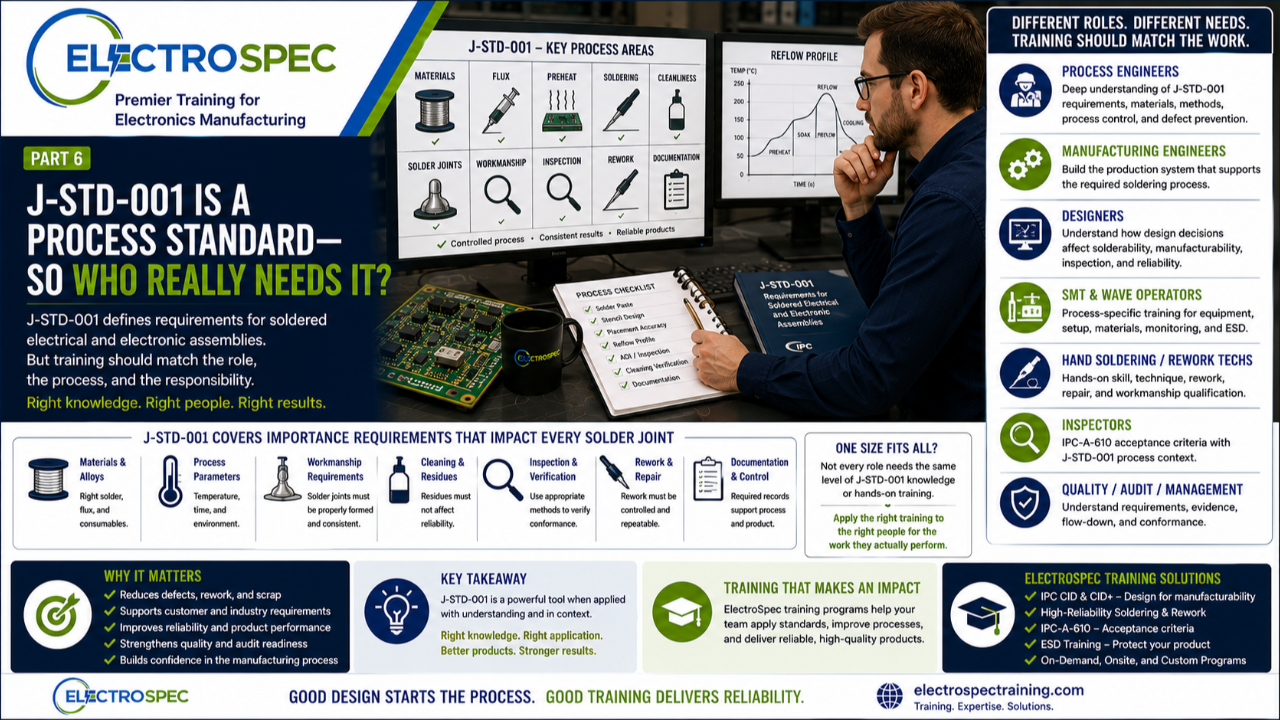
It addresses requirements for soldered electrical and electronic assemblies. It includes requirements related to materials, methods, process control, cleanliness, soldering, workmanship, inspection, and acceptance.
Because of that, many companies treat J-STD-001 as a universal soldering training requirement.
But the better question is not:
“Does everyone need J-STD-001?”
The better question is:
“Who needs J-STD-001 knowledge, and how much of it applies to the work they actually perform?”
That distinction matters.
J-STD-001 is important, but it should be applied based on role, process, product risk, and responsibility.
J-STD-001 Is Not the Same as IPC-A-610
J-STD-001 and IPC-A-610 are closely related, but they serve different purposes.
J-STD-001 focuses on requirements for soldered electrical and electronic assemblies. It is more process-oriented and includes requirements related to materials, methods, soldering, cleanliness, and workmanship.
IPC-A-610 focuses on the acceptability of completed electronic assemblies. It is commonly used by inspectors, quality personnel, manufacturing teams, auditors, and customers to evaluate the finished product.
In simple terms:
J-STD-001 helps define requirements for building soldered assemblies.
IPC-A-610 helps define whether the completed assembly is acceptable.
Both matter.
But they do not serve the same role for every employee.
Process Engineers Need J-STD-001 Knowledge
Process engineers are one of the most important audiences for J-STD-001 knowledge.
They are often responsible for developing and controlling the soldering processes used to manufacture the product.
That may include:
- solder paste selection
- flux selection
- solder alloy selection
- reflow profile development
- wave solder process control
- selective solder process control
- manual soldering process requirements
- cleanliness requirements
- cleaning verification
- thermal process control
- solderability concerns
- defect prevention
- process validation
- corrective action
- workmanship requirements
For process engineers, J-STD-001 is not just a book used for an exam.
It is a manufacturing process reference.
They need to understand how the requirements affect real production decisions.
Manufacturing Engineers Also Need Process Awareness
Manufacturing engineers may not own every soldering process parameter, but they often build the production system around the process.
They may be responsible for:
- equipment selection
- tooling
- fixtures
- workstations
- manufacturing layout
- production flow
- operator instructions
- ESD controls
- equipment maintenance planning
- process documentation
- automation support
- line balancing
- production readiness
If the product must meet J-STD-001 requirements, manufacturing engineers should understand how those requirements affect equipment, workflow, tooling, documentation, and operator execution.
They may not need the same depth as a soldering process engineer, but they need enough knowledge to build a capable manufacturing environment.
Designers Need Awareness, Not Always Hands-On Soldering Certification
Designers should understand how their design choices affect the ability to meet soldering requirements.
They influence solder joint reliability through:
- land pattern design
- component selection
- board finish
- component finish
- thermal relief
- copper distribution
- spacing
- access
- reworkability
- inspection visibility
- material selection
- environmental requirements
However, that does not mean every designer needs hands-on soldering certification.
A designer may benefit from understanding J-STD-001 concepts, but the hands-on portion of a soldering course may not match the designer’s actual job.
Designers usually do not run soldering irons on production hardware.
They do not typically operate the reflow oven.
They do not usually perform wave solder touch-up or repair.
Their role is upstream.
They need to understand how design decisions affect the process, not necessarily demonstrate production soldering skill.
SMT Operators Need Process-Specific Training
Surface mount operators work in a process-controlled environment.
Their daily responsibilities may include:
- solder paste handling
- stencil setup support
- paste printing checks
- feeder setup
- component loading
- placement verification
- reflow oven operation
- process monitoring
- ESD compliance
- basic defect recognition
- escalation when problems occur
An SMT operator may not need the same training as a person performing manual soldering.
The SMT operator needs training tied to the actual equipment, procedures, materials, alarms, setup checks, and process controls used on that line.
If they are not manually creating solder joints, then manual soldering demonstration may not be the most meaningful proof of job competence.
Hand Soldering Technicians Need Hands-On Skill
There are still many cases where hands-on soldering training is important.
This includes personnel who perform:
- manual soldering
- wire soldering
- terminal soldering
- through-hole soldering
- touch-up
- rework
- repair
- modification
- prototype assembly
- engineering changes
- special soldering operations
For these people, hands-on training and qualification make sense.
They need to demonstrate control of:
- soldering iron temperature
- tip selection
- flux use
- solder volume
- heat application
- dwell time
- wetting
- cleaning
- inspection
- damage prevention
In these roles, workmanship skill directly affects the final product.
Inspectors Need Acceptance Criteria and Process Context
Inspectors are often stronger when they understand both IPC-A-610 and J-STD-001.
IPC-A-610 helps them evaluate the completed assembly.
J-STD-001 helps them understand why certain process-related requirements matter.
An inspector may need to understand:
- solder joint acceptability
- component mounting
- cleanliness
- residues
- damage
- conductor conditions
- wire and terminal requirements
- process indicators
- defect conditions
- Class 1, Class 2, and Class 3 differences
- customer-specific requirements
The inspector’s job is not to develop the soldering process.
But inspectors who understand process context are often better at identifying meaningful problems and communicating with engineering.
J-STD-001 Training Should Not Be One-Size-Fits-All
The problem is not J-STD-001.
The problem is treating J-STD-001 training as if every role needs the same knowledge, same depth, same exam, and same hands-on demonstration.
A process engineer may need deep process understanding.
A designer may need awareness of design impacts.
An SMT operator may need process-specific machine and material training.
A hand soldering technician may need hands-on workmanship training.
An inspector may need acceptance criteria and process context.
A quality engineer may need audit, flow-down, and objective evidence understanding.
Those are different training needs.
The Role-Based View
A better training strategy looks like this:
Designers
Understand how design affects solderability, manufacturability, inspection, and reliability.
Process Engineers
Understand soldering process requirements, materials, process controls, thermal profiles, cleaning, and defect prevention.
Manufacturing Engineers
Understand how to build a production system that supports the required soldering process.
SMT and Wave Operators
Understand equipment, setup, materials, process monitoring, ESD, and escalation requirements.
Hand Soldering and Rework Technicians
Demonstrate hands-on soldering, touch-up, rework, and repair skill.
Inspectors
Understand IPC-A-610 acceptance criteria, J-STD-001 context, product requirements, and inspection evidence.
Quality Engineers and Auditors
Understand requirement flow-down, training evidence, process evidence, inspection records, and product conformance.
This approach is more accurate than simply assigning one certification to everyone.
Process Knowledge Drives Reliability
Solder joint reliability is not created by paperwork.
It is created by the interaction of design, materials, equipment, people, and process control.
J-STD-001 can help define important requirements, but companies still need to understand how those requirements apply to their specific products and processes.
For example:
- SMT solder joints may be controlled through stencil design, paste printing, placement, and reflow.
- Through-hole joints may be controlled through hole design, lead fit, preheat, flux, solder contact, and thermal relief.
- Manual solder joints may depend on operator technique and task qualification.
- Cleanliness may depend on chemistry, process control, verification, and product design.
- Rework may require special skill and additional risk control.
The training system should match those realities.
Final Thought
J-STD-001 is important.
But its value depends on how it is applied.
It should not be treated as a generic one-size-fits-all training requirement for every person in the factory.
Process engineers, manufacturing engineers, designers, operators, inspectors, and quality personnel each need different levels of understanding.
The goal is not simply to say that people were trained.
The goal is to ensure the right people understand the right requirements for the work they actually perform.
That is how J-STD-001 becomes useful.
That is how training supports manufacturing.
That is how process knowledge helps build reliable electronic products.
Related ElectroSpec Training
ElectroSpec’s High-Reliability Soldering & Rework training helps engineers, manufacturing teams, and technicians understand soldering principles, workmanship expectations, process risk, and reliability concerns.
ElectroSpec’s IPC CID and CID+ training programs help designers understand how design decisions affect solderability, manufacturability, inspection, and long-term product performance.
ElectroSpec also offers IPC-A-610 certification for personnel who need to understand completed electronic assembly acceptance criteria.
Coming Next
Designing for Inspection: If You Cannot Inspect It, Can You Accept It?
In the next article, we will explain why inspection access, test access, visibility, AOI, X-ray, hidden solder joints, and verification strategy must be considered during design—not after the product is already built.
Related Reading
- SMT Assembly Is Not Hand Soldering: Why Training Must Match the Process
- IPC-A-610 vs. IPC J-STD-001: Why A-610 Training Matters More for Operators & Inspectors
- Through-Hole Design: Wave Solder, Selective Solder, and Process Reality