
Inspection & Verification: Confirming That Quality Has Been Built In
Jul 15, 2026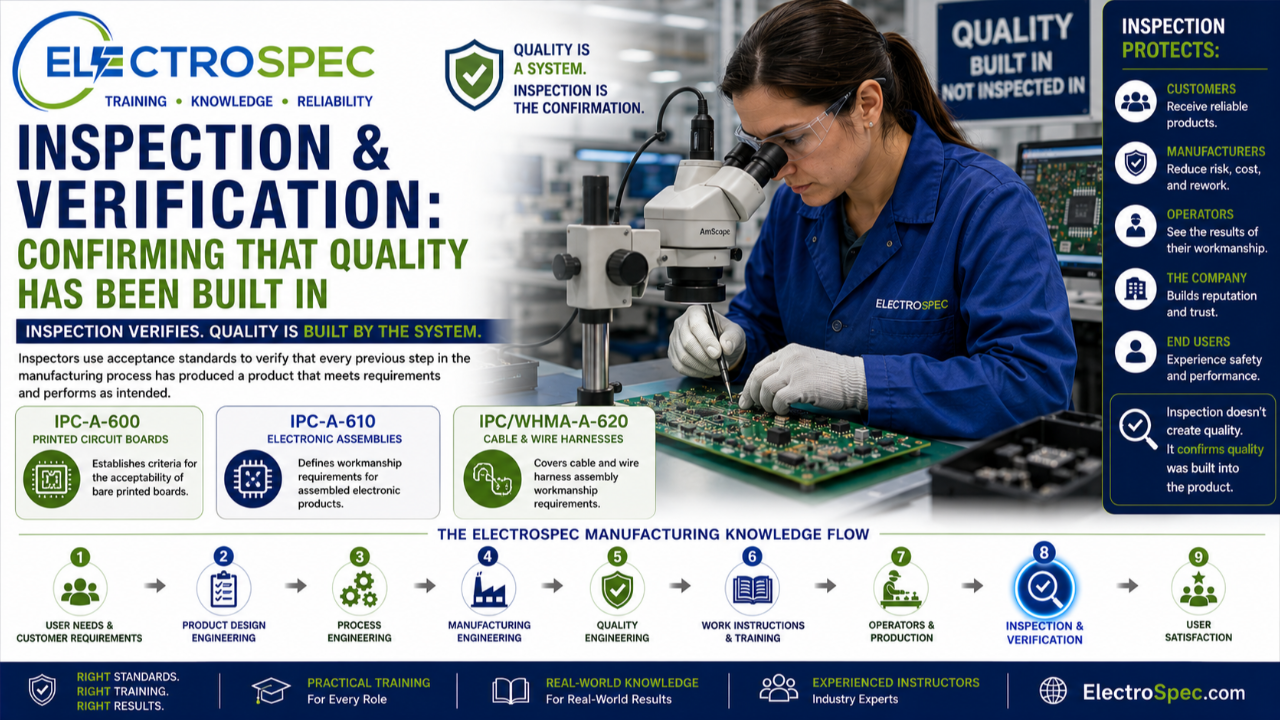
Throughout this series, we've followed the complete manufacturing journey:
User needs became customer requirements.
Customer requirements became product designs.
Designs became manufacturing processes.
Processes became production systems.
Production systems became work instructions.
Operators built the product.
Now comes the final manufacturing step before the product reaches the customer.
Inspection.
Many people believe inspection creates quality.
It doesn't.
Inspection confirms whether quality has already been built into the product.
Inspection Is Verification—Not Manufacturing
Inspectors do not solder components.
They do not design products.
They do not write work instructions.
They do not develop manufacturing processes.
Their responsibility is different.
They verify that every previous step successfully produced an acceptable product.
Inspection is the final confirmation that engineering, manufacturing, and production all worked together as intended.
Product Acceptance Standards
Inspectors rely on internationally recognized acceptance standards to determine whether products meet workmanship requirements.
Depending on the product being manufactured, this typically includes:
Printed Circuit Boards
IPC-A-600
Verifies printed circuit board acceptability.
Electronic Assemblies
IPC-A-610
Verifies completed electronic assemblies.
Cable & Wire Harness Assemblies
IPC/WHMA-A-620
Verifies cable and wire harness workmanship.
These standards define what an acceptable finished product looks like.
They provide consistency across manufacturers, customers, suppliers, and auditors.
Inspection Protects Everyone
Effective inspection benefits everyone involved.
It protects:
- Customers
- Manufacturers
- Operators
- Engineers
- Program Managers
- Regulatory Agencies
- End Users
Finding problems before products reach the customer saves enormous costs compared to discovering failures after shipment.
Inspection Is Part of a Larger Quality System
A successful inspection program depends on much more than the inspector.
Reliable inspection requires:
- Good product design
- Stable manufacturing processes
- Qualified equipment
- Proper documentation
- Effective training
- Skilled operators
- Clear acceptance criteria
Inspection verifies the effectiveness of the entire manufacturing system.
Inspectors Need Specialized Knowledge
Good inspectors develop expertise in:
- Product acceptance
- Defect recognition
- Class 1, Class 2, and Class 3 requirements
- Workmanship evaluation
- Documentation
- Process awareness
- Root cause identification
- Objective decision-making
The best inspectors understand not only what they see—but why defects occur.
The ElectroSpec Manufacturing Knowledge Flow
Today's focus is the final manufacturing step.
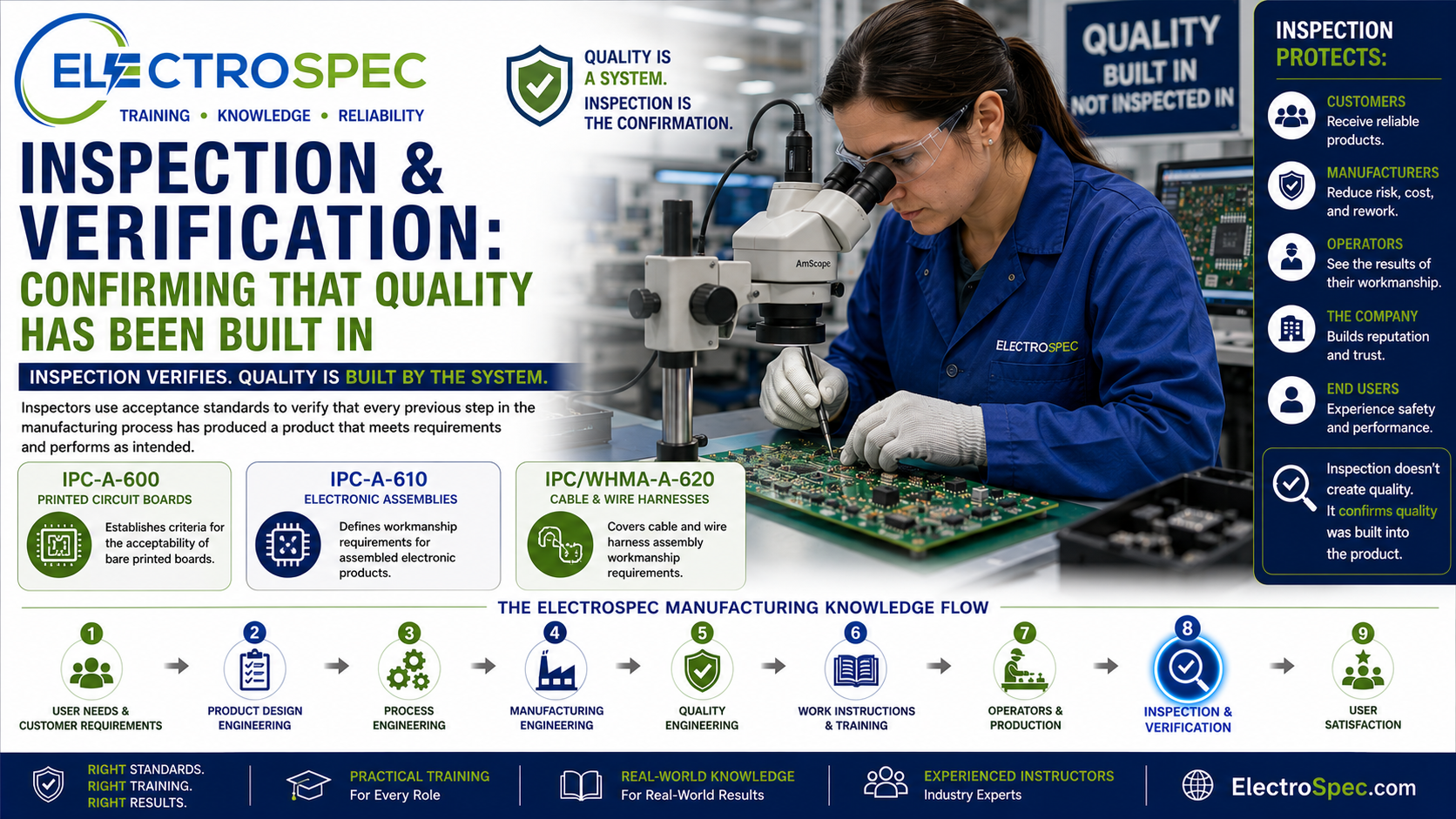
Only after successful inspection can products confidently move to the customer.
Recommended ElectroSpec Learning Path
Inspection training should match the products being evaluated.
Electronic Assembly Inspectors
- IPC-A-610
Cable & Wire Harness Inspectors
- IPC/WHMA-A-620
Printed Circuit Board Inspectors
- IPC-A-600
Additional training may include:
- ESD Control
- High-Reliability Manufacturing
- Failure Analysis
- Root Cause & Corrective Action
- Company Work Instructions
Inspectors who understand both workmanship standards and manufacturing processes provide the greatest value to their organizations.
Series Conclusion: Building Quality from the Customer Back
This series has demonstrated that reliable electronics are never the result of a single person or a single inspection.
They are the result of a connected manufacturing system that begins with understanding the user's needs and ends with delivering a product that satisfies those needs.
Every role contributes.
Every process matters.
Every standard supports the mission.
And when every step is performed correctly, quality is not inspected into the product—it is built into it from the very beginning.
Recommended ElectroSpec Training
Whether your role is designing products, developing manufacturing processes, leading production, operating assembly equipment, or performing inspections, ElectroSpec Training provides practical, role-specific education to help organizations build reliable electronic products.
From IPC CID/CID+ for design engineers, to High-Reliability Soldering for process and manufacturing engineers, to IPC-A-600, IPC-A-610, and IPC/WHMA-A-620 for operators and inspectors, our courses are designed to support the entire manufacturing lifecycle.
IPC-A-600 CIS Certification — ElectroSpec
IPC-A-610 Certification & Training Course | ElectroSpec Training
IPC/WHMA-A-620 Certification & Training Course | ElectroSpec Training