Why IPC-A-610 Should Be Your Primary Certification for Production Teams
Jun 01, 2026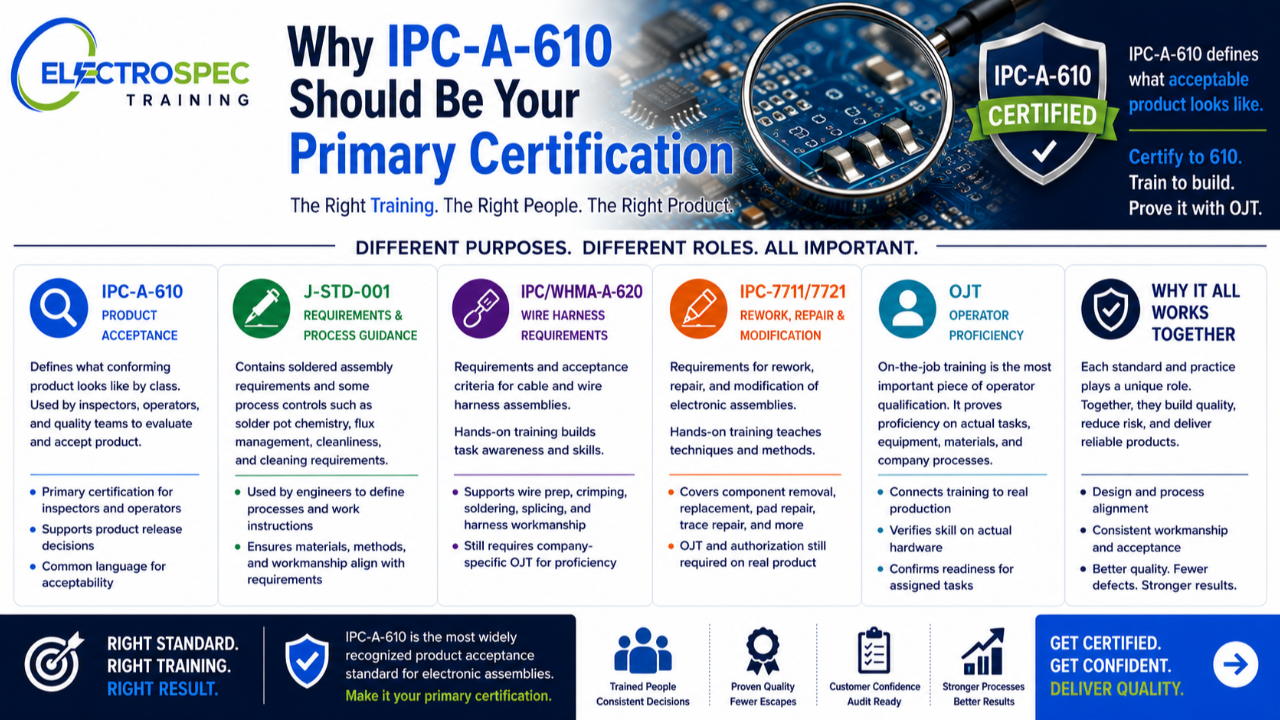
Companies often ask which IPC certification matters most for production personnel.
Should operators and inspectors be certified to IPC-A-610?
Should they be certified to J-STD-001?
Should they complete hands-on soldering, cable harness, or rework training?
The answer depends on role, but for most production teams, my recommendation is clear:
IPC-A-610 should be primary training and certification path for inspectors, operators, and quality personnel.
J-STD-001, IPC/WHMA-A-620 hands-on training, and IPC-7711/7721 hands-on training all have value. But they serve different purposes. They do not replace IPC-A-610, and they do not replace company-specific OJT.
To build effective training strategy, companies need to understand what each standard actually proves.
IPC-A-610 Defines What Acceptable Product Looks Like
IPC-A-610 is product acceptability criteria for electronic assemblies. It defines what conforming product looks like by class.
That matters because product acceptance is what determines whether hardware can move forward, ship, or be rejected.
Inspectors need IPC-A-610 because they are making acceptance decisions.
Operators need IPC-A-610 because they must understand what they are building toward and how to inspect their own work.
Quality teams need IPC-A-610 because it creates common language for product acceptance across production floor.
When IPC-A-610 is flowed down through drawing, purchase order, contract, or quality requirements, it becomes acceptance language for finished product. It tells team what to expect, what to verify, and what class-based workmanship condition applies.
For inspectors and operators, that is critical.
They do not normally set process. They inspect, build, verify, and respond to requirements already established by engineering, customer flow-down, work instructions, and quality system.
That is why IPC-A-610 is so powerful as certification foundation.
It teaches personnel what acceptable product looks like.
J-STD-001 Supports Requirements, But It Does Not Create Operator Proficiency
J-STD-001 is important, but it is often misunderstood.
J-STD-001 is not simply a process-control document, and it is not a complete operator skill-development program. It contains requirements for soldered electrical and electronic assemblies, and it includes some process-control requirements, such as solder pot chemistry, flux control, cleanliness, cleaning requirements, material controls, and workmanship-related expectations.
Those requirements matter.
But inspectors and operators usually do not create those processes. Process engineers, manufacturing engineers, product engineers, and quality engineers typically define process controls, material requirements, cleaning methods, flux usage, soldering parameters, work instructions, and acceptance flow.
J-STD-001 is very useful at engineering and process ownership level.
It helps define how compliant soldering processes should be controlled.
It helps ensure work instructions, materials, cleaning methods, and workmanship expectations align with applicable requirements.
But it does not, by itself, make an operator proficient.
Certification Is Not Same as Production Readiness
One of most important requirements connected to J-STD-001 is operator proficiency. Operators must be proficient for tasks they perform.
That proficiency does not come from certification alone.
It comes from task-specific, company-specific, hardware-specific training.
J-STD-001 classroom training and certification can support baseline knowledge, but it has limited value when treated as proof that someone is fully ready for production work.
A person can pass certification using classroom equipment, classroom boards, controlled samples, and limited exercises, yet still not be ready to perform high-reliability soldering on actual production hardware next day.
That is not criticism of certification.
It is reality.
Production soldering depends on actual board design, actual thermal mass, actual component types, actual heat sinks, actual soldering stations, actual tip geometry, actual flux, actual solder wire, actual solder paste, actual cleanliness requirements, actual work instructions, and actual customer restrictions.
An engineer, trainer, or inspector may understand J-STD-001 well enough to pass certification, but that does not automatically mean they are ready to perform aerospace manual soldering on live product.
Knowledge and proficiency are not the same thing.
Certification supports knowledge.
OJT proves production capability.
Why J-STD-001 Hands-On Training Has Limited Proof Value
J-STD-001 hands-on training can be useful. It can introduce soldering concepts, workmanship expectations, and basic technique. It can help reinforce requirements.
But companies should not overstate what it proves.
Most companies do not build same product used in certification exercises. They use different assemblies, different board thicknesses, different component packages, different heat sinks, different flux systems, different solder wire, different solder paste, different tip sizes, different thermal profiles, and different process restrictions.
That means a generic hands-on soldering exercise may not represent actual production work.
A classroom board may be clean, controlled, simple, and designed for training.
Real production hardware may be dense, thermally demanding, customer-specific, Class 3, coated, reworked, limited-access, or highly sensitive to heat, cleanliness, or handling.
That is why J-STD-001 hands-on certification should not be treated as final proof of operator readiness.
It helps.
But it does not replace OJT.
Where IPC/WHMA-A-620 Hands-On Training Fits
IPC/WHMA-A-620 hands-on training also has value, especially for cable and wire harness operations.
It can support understanding of wire preparation, crimping, soldering, splicing, cable assembly workmanship, harness acceptability, and related production expectations.
But just like J-STD-001, it does not automatically prove someone is ready for company-specific production work.
Real harness proficiency depends on actual wire types, insulation systems, contact systems, tooling, strip lengths, crimp height requirements, pull-test requirements, solder sleeves, shield terminations, customer flow-downs, and internal process controls.
A hands-on class can introduce methods.
Company OJT proves whether operator can perform assigned work correctly with actual tools, materials, and hardware.
Where IPC-7711/7721 Hands-On Training Fits
IPC-7711/7721 hands-on training is valuable for rework, repair, and modification.
It can help personnel understand component removal, component replacement, pad repair, trace repair, land repair, jumper wires, lifted pads, laminate damage, and other rework or repair methods.
But rework and repair are highly product-specific.
Actual proficiency depends on board construction, laminate type, pad geometry, component sensitivity, customer restrictions, thermal limitations, coatings, cleanliness requirements, and repair authorization.
A student may perform well in a training environment and still need internal qualification before touching live customer hardware.
IPC-7711/7721 hands-on training supports technique development.
OJT and internal authorization prove whether someone can safely perform those techniques on actual product.
OJT Is Where Real Operator Proficiency Is Proven
On-the-job training is most important piece of operator qualification.
OJT connects training to actual production reality.
It verifies operator proficiency using company equipment, company materials, company processes, company work instructions, and actual or representative hardware.
That is where real capability is built.
A strong OJT program should confirm that operators can perform assigned tasks correctly, understand applicable work instructions, use correct tools and materials, recognize defects, control cleanliness, follow process requirements, and produce conforming work.
This is especially important for high-reliability, aerospace, defense, medical, and Class 3 production environments.
Certification can support OJT.
But certification should not replace OJT.
Best Certification Strategy for Production Teams
For most companies, best strategy is not to certify everyone to every standard.
Best strategy is to align certification with role.
IPC-A-610 should be primary certification for inspectors, operators, quality personnel, and anyone involved in product acceptance.
It gives production team common understanding of what acceptable product looks like.
It supports product release decisions.
It helps operators inspect their own work.
It helps inspectors apply class-based acceptance criteria consistently.
J-STD-001 should be emphasized for engineering, process ownership, work instruction development, materials control, cleaning requirements, flux management, soldering process control, and quality system alignment.
It helps define how process should be controlled, but it does not replace operator OJT.
IPC/WHMA-A-620 hands-on training should be used where cable and wire harness work requires task awareness and skill development.
It supports training, but company-specific OJT still proves proficiency.
IPC-7711/7721 hands-on training should be used where rework, repair, or modification skills are required.
It supports technique development, but actual product authorization still requires internal verification.
Simple Breakdown
IPC-A-610 teaches what acceptable product looks like.
J-STD-001 supports soldering requirements, process expectations, materials, cleaning, flux control, and work instruction development.
IPC/WHMA-A-620 hands-on training supports cable and wire harness task awareness.
IPC-7711/7721 hands-on training supports rework and repair technique development.
OJT proves operators can perform assigned tasks on actual hardware.
Companies need all of these tools, but they should not confuse them.
Bottom Line
If a company wants to ensure product leaving factory conforms to required class requirements, IPC-A-610 is the best certification foundation for inspectors, operators, and production quality teams.
J-STD-001 matters.
Hands-on training matters.
IPC/WHMA-A-620 and IPC-7711/7721 matter when applicable.
But none of them replace IPC-A-610 as primary product acceptance training, and none of them replace OJT as proof of real operator proficiency.
For most production teams, IPC-A-610 is the way to go.
It teaches people what acceptable product looks like.
It supports consistent release decisions.
It gives operators and inspectors common language.
And it helps protect product quality before hardware leaves factory.
Need help choosing right IPC certification path for your production team? ElectroSpec can help align IPC-A-610, J-STD-001, IPC/WHMA-A-620, IPC-7711/7721, and OJT into one practical training strategy.
IPC-A-610 CIS Certification — ElectroSpec