
Why IPC-A-610 Is the Standard Everyone in Electronics Manufacturing Should Understand
Jun 05, 2026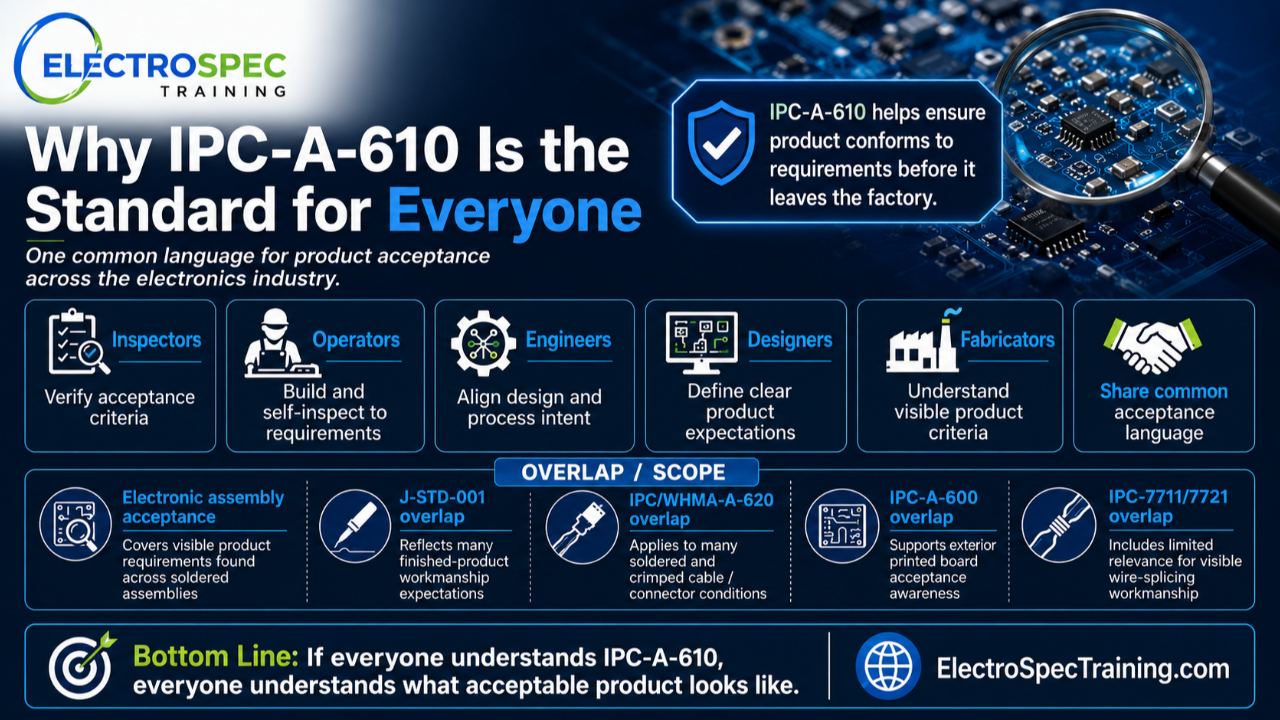
In electronics manufacturing, every role looks at product from a slightly different perspective.
Inspectors verify acceptability.
Operators build and self-inspect their work.
Engineers define processes and resolve technical issues.
Designers create product requirements and documentation.
Fabricators build printed boards.
Customers define expectations and receive final product.
Each role is different, but they all need one common language for product acceptance.
That common language is IPC-A-610.
IPC-A-610 is not just for inspectors. It is one of the most important standards for anyone involved in electronic assemblies because it helps everyone understand what acceptable product looks like before hardware leaves factory.
IPC-A-610 Helps Ensure Product Conforms to Requirements
The purpose of production is not simply to build hardware.
The purpose is to build hardware that conforms to requirements.
That means product must meet drawing requirements, purchase order requirements, customer requirements, class requirements, workmanship requirements, and applicable IPC acceptance criteria.
IPC-A-610 supports that goal by providing visible acceptance criteria for electronic assemblies. It helps define what is acceptable, what is defective, and what may require process indicator review or additional evaluation.
This matters because product release decisions must be based on requirements, not opinion.
When everyone understands IPC-A-610, inspection becomes more consistent. Operators better understand what they are trying to build. Engineers better understand how process outcomes are judged. Customers better understand what product acceptability means.
IPC-A-610 gives everyone a shared product acceptance language.
IPC-A-610 Is Not Just for Inspectors
Many companies think of IPC-A-610 as an inspector standard.
That is true, but incomplete.
Inspectors absolutely need IPC-A-610 because they are responsible for evaluating product acceptability. They need to know class requirements, defect conditions, process indicators, target conditions, and when product does or does not meet acceptance criteria.
But operators also need IPC-A-610.
Operators must understand what they are building toward. They need to inspect their own work before it ever reaches final inspection. When operators understand IPC-A-610, they can catch issues earlier, reduce rework, and avoid passing nonconforming conditions downstream.
Engineers also benefit from IPC-A-610.
Process engineers, manufacturing engineers, quality engineers, and product engineers need to understand how finished product will be evaluated. That helps them develop work instructions, troubleshoot defects, improve process controls, and communicate clearly with production and quality teams.
Designers benefit as well.
Designers may not inspect production hardware every day, but they make decisions that influence final product appearance, manufacturability, assembly quality, and inspection outcomes. Understanding IPC-A-610 helps designers think about how their designs will be built, inspected, and accepted.
Fabricators and suppliers benefit because IPC-A-610 helps clarify visible product expectations after assembly.
Customers benefit because IPC-A-610 provides a common framework for discussing workmanship, class expectations, and product release criteria.
In short, IPC-A-610 is not just an inspection document.
It is a communication tool across the electronics manufacturing chain.
IPC-A-610 Aligns Product Acceptance Across Roles
A major benefit of IPC-A-610 is alignment.
Without a common acceptance standard, each group may interpret product quality differently.
An operator may think a condition is acceptable because product functions.
An inspector may reject it because workmanship does not meet class requirements.
An engineer may see it as a process issue.
A customer may see it as a quality escape.
A designer may not realize design features contributed to the condition.
IPC-A-610 helps reduce these disconnects.
It gives teams a shared way to discuss product conditions, including solder joints, component mounting, terminals, wires, connectors, staking, cleanliness, damage, marking, coating, hardware, and visible printed board conditions.
When teams use IPC-A-610 consistently, they are not arguing from personal preference. They are evaluating product against common acceptance criteria.
That improves communication.
It also improves quality.
IPC-A-610 Connects to Many Other Standards
One reason IPC-A-610 is so valuable is that it overlaps with product-facing requirements from several other standards.
It does not replace every standard.
It does not replace engineering judgment.
It does not replace company procedures.
But it does capture a large portion of visible product acceptability that production personnel need to understand.
IPC-A-610 includes many finished-product acceptance requirements related to soldered electronic assemblies. This makes it closely connected to J-STD-001 outcomes.
J-STD-001 is important for soldered assembly requirements, materials, methods, process controls, cleanliness, flux management, and related process expectations. But IPC-A-610 is where many people see what those requirements look like on finished product.
IPC-A-610 also overlaps with many cable, wire, connector, soldered, and crimped conditions that relate to IPC/WHMA-A-620.
IPC/WHMA-A-620 is still the primary standard for cable and wire harness assemblies. However, many electronic assemblies include wires, connectors, terminals, crimped contacts, soldered wires, and related workmanship conditions. IPC-A-610 gives production teams useful acceptance awareness for many of those visible conditions.
IPC-A-610 also includes visible printed board conditions that connect to IPC-A-600.
IPC-A-600 is acceptability of printed boards, especially as supplied by fabricators. IPC-A-610 does not replace IPC-A-600, but it does help assembly teams understand visible board conditions that may affect final assembly acceptability.
IPC-A-610 may also touch limited workmanship areas related to rework and repair, including certain wire splice or repair-related conditions that may connect to IPC-7711/7721.
IPC-7711/7721 remains proper reference for rework, modification, and repair procedures. But IPC-A-610 helps teams evaluate whether final visible product condition is acceptable after work is completed.
This is why IPC-A-610 has such broad practical value.
It sits at point where product is being judged.
IPC-A-610 Helps Operators Build Better Product
Operators are not just builders.
Operators are first line of quality.
Every operator should understand what acceptable work looks like before product reaches final inspection.
When operators understand IPC-A-610, they can self-inspect more effectively. They can recognize poor solder wetting, component misalignment, lead issues, polarity concerns, wire damage, connector concerns, cleanliness issues, coating defects, board damage, or other visible workmanship problems earlier in process.
This does not mean operators set acceptance policy.
It means operators understand requirements they are building toward.
That is powerful.
A company that only trains inspectors to IPC-A-610 may still catch defects, but it catches them late.
A company that trains operators to IPC-A-610 can prevent many defects earlier.
That reduces rework, improves yield, and helps protect product before it moves downstream.
IPC-A-610 Helps Inspectors Make Consistent Decisions
Inspectors need consistency.
Without IPC-A-610, inspection can become subjective. One inspector may accept condition. Another may reject it. One shift may interpret requirements differently than another shift.
IPC-A-610 reduces that variation.
It provides visual acceptance criteria, class-based requirements, and common terminology.
This helps inspectors make decisions based on requirements, not personal preference.
It also helps inspection teams explain decisions to operators, engineers, suppliers, and customers.
A good inspector does not simply say, “I do not like this condition.”
A good inspector can explain whether product meets or does not meet acceptance criteria.
IPC-A-610 gives inspectors that foundation.
IPC-A-610 Helps Engineers Understand Product Outcomes
Engineers define processes, troubleshoot problems, evaluate defects, and improve production systems.
To do that well, engineers need to understand how finished product is judged.
IPC-A-610 helps engineers connect process decisions to product outcomes.
If solder joints show insufficient wetting, engineers may need to evaluate flux, solderability, thermal profile, tip temperature, dwell time, surface finish, contamination, or operator technique.
If wires show damage, engineers may need to evaluate stripping tools, bend radius, handling, routing, strain relief, or work instructions.
If components are misaligned, engineers may need to evaluate placement equipment, land pattern design, solder volume, reflow profile, or manual assembly controls.
IPC-A-610 helps engineers see final product conditions clearly and connect those conditions back to root causes.
That makes it useful for process improvement, failure analysis, corrective action, supplier quality, and production support.
IPC-A-610 Helps Designers Understand Downstream Impact
Designers may work upstream, but their decisions affect everything downstream.
Land pattern choices, spacing, component orientation, board density, access for soldering, test points, via placement, connector locations, board edge clearances, labeling, coating keep-outs, and documentation all affect assembly and inspection.
When designers understand IPC-A-610, they can better appreciate how product will be inspected and accepted.
This helps designers avoid creating unnecessary workmanship risks.
A design may meet electrical requirements but still be difficult to assemble, inspect, or rework.
IPC-A-610 helps designers think beyond layout and consider final product quality.
IPC-A-610 Helps Customers and Suppliers Speak Same Language
Customers and suppliers often need a neutral standard to discuss acceptability.
IPC-A-610 provides that common language.
When a purchase order, drawing, or contract specifies IPC-A-610 and product class, both sides have clearer expectations.
The supplier knows what workmanship level is expected.
The customer knows what criteria applies during acceptance.
Quality teams have a standard for resolving questions.
This helps reduce disputes and prevents acceptance decisions from becoming purely subjective.
For customer-supplier relationships, IPC-A-610 is more than a training standard.
It is a communication standard.
IPC-A-610 Does Not Replace OJT or Process Control
IPC-A-610 is extremely important, but it does not replace everything.
It does not replace J-STD-001 process requirements.
It does not replace IPC/WHMA-A-620 for full cable and wire harness acceptance.
It does not replace IPC-A-600 for printed board acceptability.
It does not replace IPC-7711/7721 for rework, repair, and modification procedures.
It does not replace company-specific OJT.
Operators still need task-specific training on actual equipment, actual hardware, actual materials, actual work instructions, and actual company processes.
IPC-A-610 teaches what acceptable product looks like.
OJT teaches and verifies how operators produce that acceptable product using company-specific methods.
Both are needed.
The mistake is thinking certification alone proves production proficiency.
It does not.
Certification supports knowledge.
OJT proves capability.
Why IPC-A-610 Is the Best Common Training Foundation
If a company can only pick one IPC certification to establish common product acceptance understanding across production, IPC-A-610 is strongest choice.
It applies broadly across electronic assemblies.
It helps inspectors make consistent acceptance decisions.
It helps operators self-inspect.
It helps engineers understand finished product outcomes.
It helps designers understand downstream inspection and acceptability issues.
It helps fabricators and suppliers understand visible product expectations.
It helps customers and manufacturers communicate clearly.
That makes IPC-A-610 one of most practical and widely useful standards in electronics manufacturing.
Simple Role-Based Breakdown
Inspectors use IPC-A-610 to verify product acceptance.
Operators use IPC-A-610 to understand what acceptable work looks like and to self-inspect.
Engineers use IPC-A-610 to connect process performance to finished product quality.
Designers use IPC-A-610 to understand downstream assembly and inspection impact.
Fabricators and suppliers use IPC-A-610 to understand visible product expectations after assembly.
Customers use IPC-A-610 to define and communicate acceptance expectations.
Everyone benefits from common acceptance language.
Bottom Line
IPC-A-610 is standard everyone in electronics manufacturing should understand because it defines what acceptable electronic assembly product looks like.
It helps ensure product conforms to requirements before it leaves factory.
It aligns inspectors, operators, engineers, designers, fabricators, suppliers, and customers around common acceptance expectations.
It connects to many visible product requirements found across soldered assemblies, cable and wire harness conditions, printed board conditions, and some rework or repair outcomes.
Other standards still matter.
J-STD-001 matters for soldering requirements and process expectations.
IPC/WHMA-A-620 matters for cable and wire harness assemblies.
IPC-A-600 matters for printed board acceptability.
IPC-7711/7721 matters for rework, repair, and modification.
OJT matters for proving operator proficiency.
But IPC-A-610 is the standard that brings everyone together at final product acceptance.
If everyone understands IPC-A-610, everyone understands what acceptable product should look like.
That is why IPC-A-610 is the standard for everyone.
Related Reading
Get IPC-A-610 Certified On Demand
If your inspectors, operators, engineers, designers, or quality personnel need a stronger understanding of electronic assembly acceptance requirements, IPC-A-610 is the best place to start.
ElectroSpec’s IPC-A-610 On-Demand Certification Course gives students flexible, 24/7 access to training so they can learn at their own pace, review difficult sections, and prepare with confidence.
This course is ideal for production teams that need a common understanding of what acceptable product looks like before hardware leaves the factory.
With ElectroSpec’s IPC-A-610 On-Demand Course, students receive:
- 24/7 on-demand course access
- IPC-A-610 certification preparation
- Practice exam support
- Instructor support
- Remote proctored exam scheduling
- One free retake, if needed
- ElectroSpec certificate of completion
Train your team to understand acceptance criteria, improve inspection consistency, reduce quality escapes, and protect your product before it reaches your customer.
Enroll in ElectroSpec’s IPC-A-610 On-Demand Certification Course today at ElectroSpecTraining.com.
IPC-A-610 teaches what acceptable product looks like. ElectroSpec helps your team get certified.
IPC-A-610 CIS Certification — ElectroSpec