
IPC Certification Does Not Prove Product Conformance
Jul 17, 2026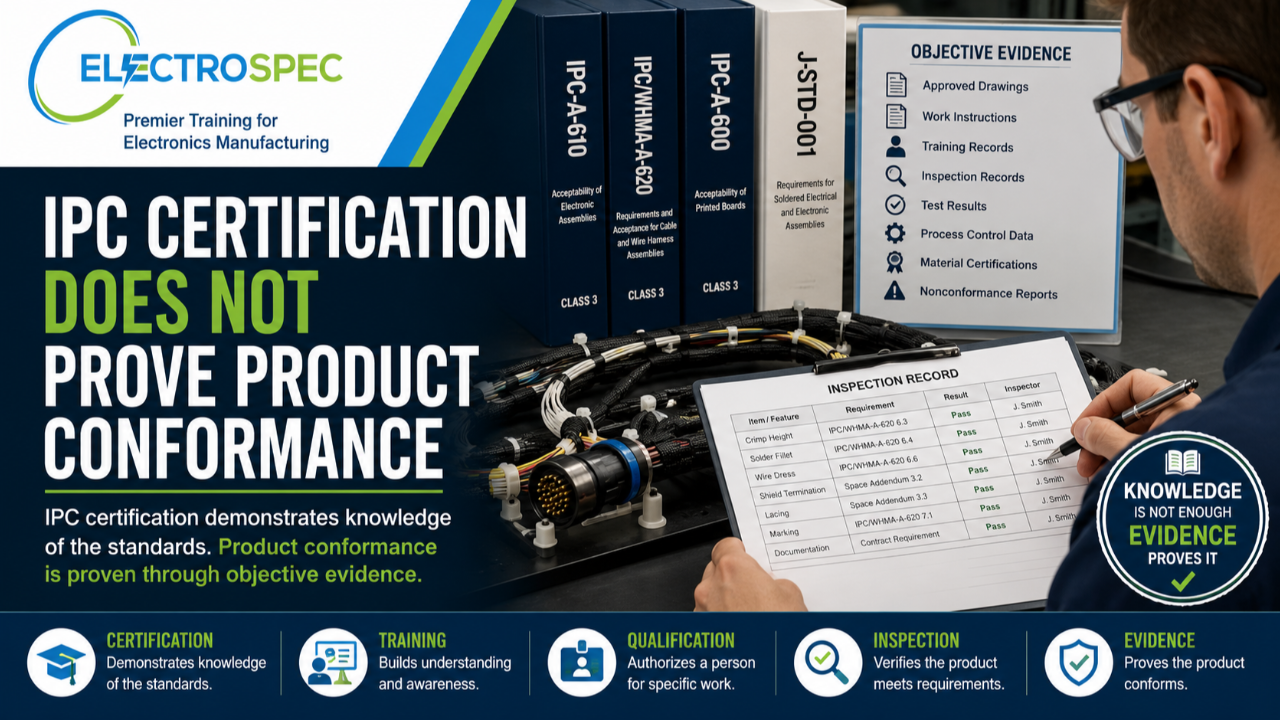
In the first article of this series, we discussed what it means when a drawing calls out IPC Class 3, IPC/WHMA-A-620, IPC-A-610, IPC-A-600, J-STD-001, or Space Addendum requirements.
The key point was simple:
A drawing note defines what the product must meet. It does not automatically define who must hold a certificate.
Now we need to address the next common misunderstanding.
Many organizations treat an IPC certificate as proof that the product conforms.
That is not what certification proves.
What IPC Certification Actually Demonstrates
IPC certification is valuable, but it has a specific purpose.
At its core, IPC certification demonstrates that a student completed a defined certification program and can use the applicable standard to answer questions, interpret conditions, locate requirements, and apply the criteria in the document.
That is important.
Standards can be complex. Knowing how to navigate them matters. Inspectors, engineers, operators, quality personnel, and auditors all benefit from understanding how the requirements are structured and how acceptance criteria are applied.
But that does not mean certification proves that a specific product was manufactured correctly.
Certification Is Not Product Evidence
An IPC certificate does not prove that:
- A specific cable harness meets IPC/WHMA-A-620 requirements
- A specific electronic assembly meets IPC-A-610 requirements
- A specific printed board meets IPC-A-600 requirements
- A specific solder joint meets J-STD-001 requirements
- A specific Space Addendum requirement was properly flowed down
- A specific operator performed the work correctly
- A specific inspector found every defect
- A manufacturing process was capable
- A finished product meets the drawing
A certificate supports personnel knowledge.
It does not replace product evidence.
Product Conformance Requires Objective Evidence
Product conformance is proven through objective evidence tied to the actual product, process, and requirement.
That evidence may include:
- Approved drawings
- Contract and purchase order requirements
- Customer flow-down clauses
- Work instructions
- Inspection plans
- Manufacturing records
- In-process inspection records
- Final inspection records
- Test records
- Process control data
- Material certifications
- Tooling records
- Training or qualification records
- Nonconformance and corrective action records
Training records may be part of the evidence package, but they are not the entire package.
A certificate can show that a person was trained or certified.
It does not show that the product conforms.
The Problem with “Show Me Your Certificate” Audits
One of the weakest audit approaches is simply asking:
“Show me your IPC certificate.”
That question may verify that someone holds a credential, but it does not verify that the product meets the drawing.
A stronger audit asks:
- What requirement is invoked?
- Where is that requirement flowed into the work instruction?
- Which product features are affected?
- What acceptance criteria apply?
- Who is authorized to perform the work?
- How was that person trained or qualified?
- What inspection evidence shows the product met the requirement?
- What happens when a defect is found?
- How is recurrence prevented?
That type of audit follows the requirement through the manufacturing system.
It does not stop at a certificate.
Knowing the Requirement Is Not the Same as Building the Product
There is another important distinction.
A person may understand a requirement and still not be proficient at performing the task.
For example, a person may be able to find and apply a requirement in a standard but still not be qualified to build a high-reliability space cable harness, perform complex soldering, assemble RF connectors, terminate coaxial cable, or inspect a product without defect escapes.
Knowledge matters.
But skill, experience, tooling, supervision, work instructions, and product-specific qualification also matter.
That is especially important in high-reliability manufacturing, where workmanship errors may not be immediately obvious but can affect long-term product performance.
Certification Supports the System
This does not mean certification has no value.
It does.
Certification can help personnel:
- Understand the standard
- Use correct terminology
- Recognize acceptance conditions
- Apply workmanship requirements
- Communicate with customers and auditors
- Support inspection consistency
- Strengthen the training system
But certification should be used as part of a larger system.
It should not be treated as a shortcut for proving product conformance.
The Better Question
Instead of asking:
“Are your people IPC certified?”
A better question is:
“How do you prove this product meets the invoked IPC requirement?”
That question leads to a much stronger discussion.
It requires looking at the drawing, contract, process, work instruction, training program, inspection plan, records, and actual product evidence.
That is how high-reliability electronics manufacturing should be evaluated.
Final Thought
IPC certification supports knowledge of the standard.
Product conformance requires objective evidence that the product meets the drawing, contract, customer, and acceptance requirements.
Those two ideas are related, but they are not the same.
A certificate may support the training system.
It may help demonstrate that personnel understand the applicable standard.
But the product itself must still be manufactured, inspected, tested, and documented in a way that proves conformance to the invoked requirements.
In high-reliability electronics manufacturing, confidence comes from the complete system—not from a certificate alone.
Need Help With IPC Conformance Evidence?
If your team is being asked to prove IPC-A-610, IPC-A-600, IPC/WHMA-A-620, Class 3, or Space Addendum conformance, ElectroSpec can help clarify what evidence may be needed beyond training certificates.
ElectroSpec offers IPC/WHMA-A-620 base CIS certification and supports electronics manufacturers with standards interpretation, training strategy, inspection expectations, and requirement flow-down discussions.
Coming Next
Training, Certification, Qualification & Proficiency Are Not the Same Thing
In the next article, we will explain why training, certification, qualification, and proficiency are related—but very different—parts of a real electronics manufacturing training system.
Related Reading
Get Certified with ElectroSpec
IPC-A-610 Certification — CIS, CIT and CSE certification for electronic assembly acceptance
IPC/WHMA-A-620 Certification — CIS, CIT and CSE certification for cable and wire harness acceptance