
Manufacturing Engineering: Where Great Designs Become Great Products
Jul 24, 2026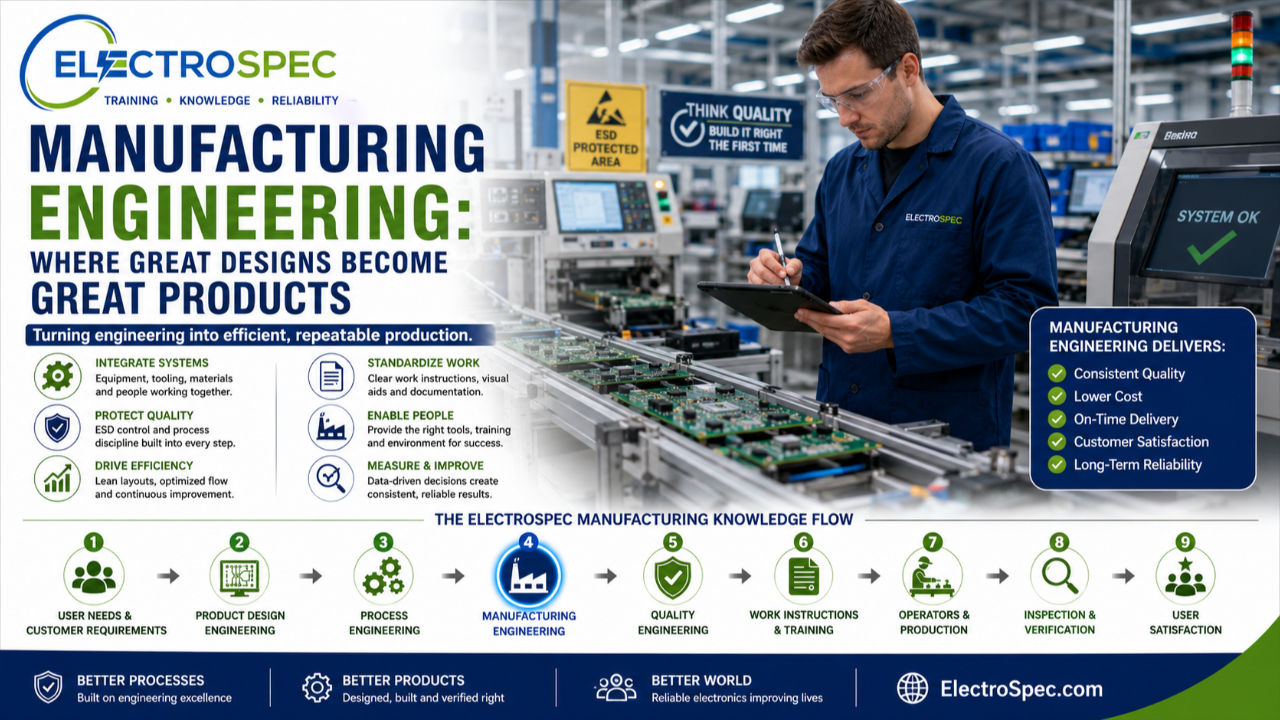
In the previous articles of this series, we explored how user needs become customer requirements, how product engineers transform those requirements into designs, and how process engineers develop the methods used to manufacture reliable electronic assemblies.
The next step is where those plans become reality.
Manufacturing engineering brings together people, equipment, materials, facilities, work instructions, and production systems to consistently build products that meet customer expectations.
Without manufacturing engineering, even the best design and the best manufacturing process remain only ideas.
Manufacturing Engineering Builds the Factory Around the Product
Manufacturing engineers answer questions such as:
- What equipment is required?
- How should the production line be arranged?
- Which tools and fixtures are needed?
- How will operators perform each task?
- What documentation is required?
- How will ESD protection be maintained?
- How will materials flow through production?
- How will defects be minimized?
- How will production be measured and improved?
Their job is to make manufacturing repeatable—not dependent upon individual skill alone.
Manufacturing Engineering Is More Than Equipment
Many people associate manufacturing engineering with machines.
In reality, manufacturing engineering integrates every element required to produce consistent quality.
This includes:
- Production equipment
- Assembly fixtures
- Tooling
- Automation
- ESD control systems
- Material handling
- Factory layout
- Operator workstations
- Manufacturing software
- Traceability systems
- Visual work instructions
- Production documentation
- Continuous improvement
The manufacturing engineer creates an environment where quality becomes the normal outcome rather than an exception.
Good Operators Need Good Systems
Excellent operators cannot compensate for poor manufacturing systems.
If work instructions are confusing...
If equipment is poorly maintained...
If tooling is inadequate...
If ESD controls are ineffective...
If materials are unavailable...
Even highly skilled employees struggle to produce consistent results.
Manufacturing engineering removes unnecessary variation before production begins.
Manufacturing Engineering Connects Every Department
Manufacturing engineering serves as the bridge between engineering and production.
It translates engineering intent into practical manufacturing operations while working closely with:
- Product Design Engineers
- Process Engineers
- Quality Engineers
- Production Supervisors
- Operators
- Inspectors
- Supply Chain
- Maintenance
- Customers
Every department depends on manufacturing engineering to create an efficient production environment.
ESD Is a Manufacturing Engineering Responsibility
One of the most overlooked responsibilities of manufacturing engineering is establishing an effective Electrostatic Discharge (ESD) control program.
An ESD program is far more than wrist straps and grounded mats.
Manufacturing engineers work with quality engineers and ESD coordinators to implement:
- EPA design
- Personnel grounding
- Equipment grounding
- Packaging
- Material handling
- Environmental controls
- Compliance verification
- Training requirements
- Periodic auditing
Without these systems, invisible ESD damage can reduce product reliability long before defects become visible.
Manufacturing Systems Build Consistency
The goal of manufacturing engineering is consistency.
Consistent equipment.
Consistent materials.
Consistent work instructions.
Consistent operator performance.
Consistent product quality.
When manufacturing systems are stable, operators can focus on building quality products instead of overcoming unnecessary obstacles.
The ElectroSpec Manufacturing Knowledge Flow
Today's article focuses on the fifth step of the Manufacturing Knowledge Flow.
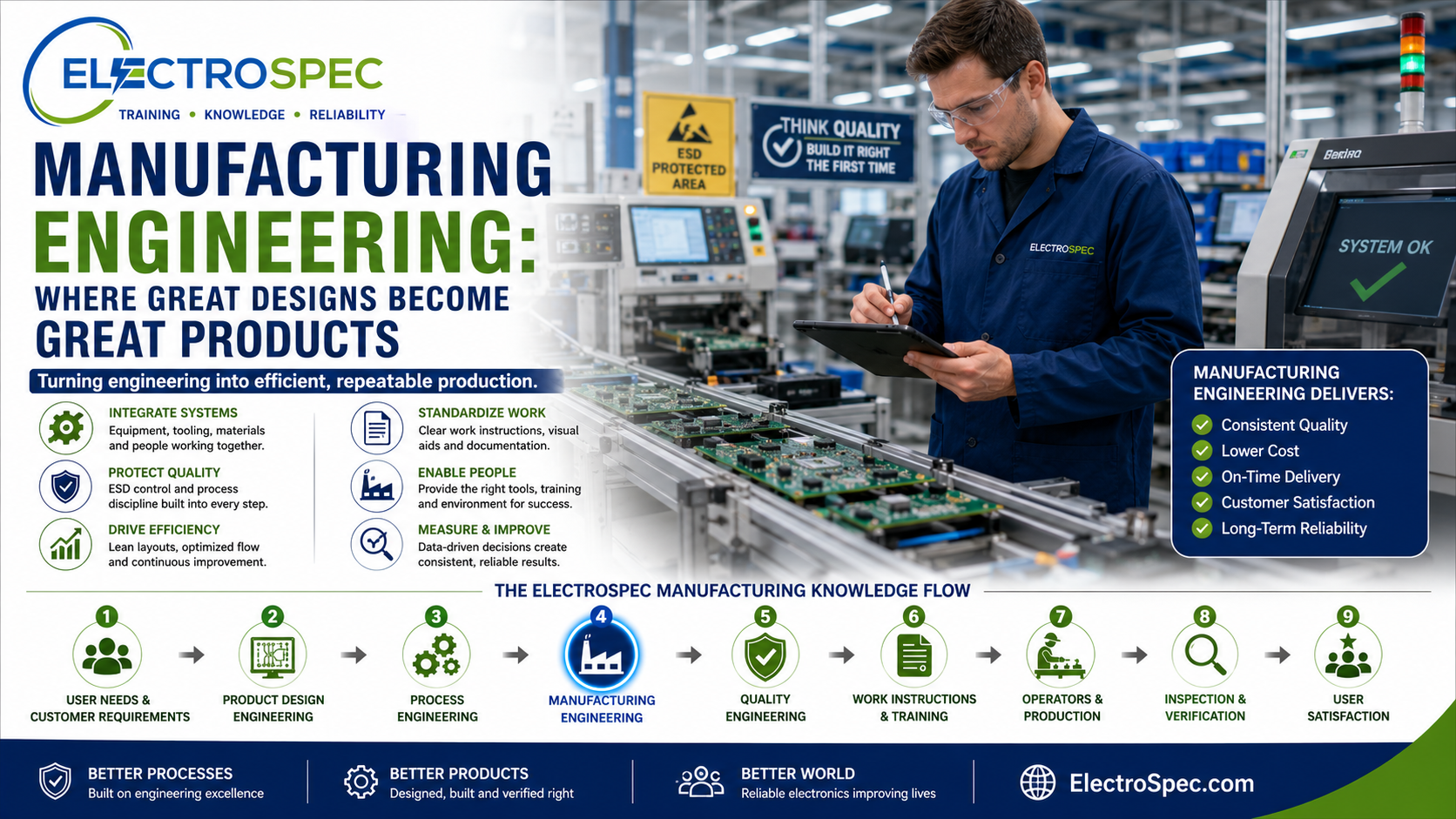
Each step builds upon the foundation established by the previous one.
Recommended ElectroSpec Learning Path
Manufacturing engineers benefit from understanding far more than production scheduling.
Recommended knowledge includes:
- IPC-A-610 (Electronic Assembly Acceptance)
- IPC/WHMA-A-620 (Cable & Wire Harness Acceptance)
- IPC-A-600 (Printed Board Acceptability)
- iNARTE ESD Engineer or Technician (depending on responsibilities)
- High-Reliability Soldering & Rework
- Manufacturing process improvement
- Root cause analysis
- Continuous improvement
The most effective manufacturing engineers understand both engineering principles and the realities of the production floor.
Coming Next
Quality Engineering: Building Confidence Through Process Verification
We'll examine how quality engineers establish process controls, audits, data analysis, corrective actions, and continuous improvement systems that keep manufacturing performing at its highest level.
Soldering for High Reliability
IPC-A-600 CIS Certification — ElectroSpec
IPC-A-610 Certification & Training Course | ElectroSpec Training
IPC/WHMA-A-620 Certification & Training Course | ElectroSpec Training
iNARTE ESD Engineer Certification — ElectroSpec
iNARTE ESD Technician Certification — ElectroSpec