
Operators: The Skilled Professionals Who Build Quality Every Day
Jul 14, 2026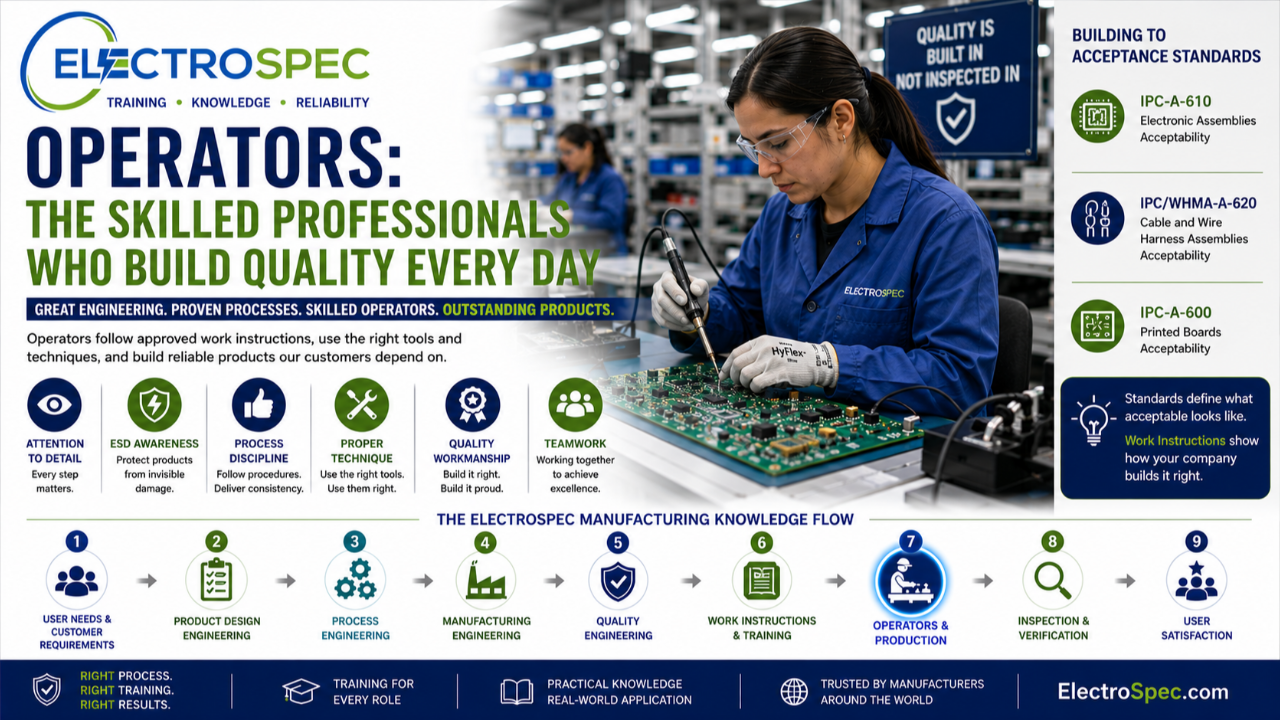
Throughout this series, we've followed the ElectroSpec Manufacturing Knowledge Flow from user needs through product design, process engineering, manufacturing engineering, quality engineering, and work instructions.
Now we arrive at the people who transform engineering into reality.
The operator.
Every electronic assembly, cable harness, printed circuit board, or electromechanical product is ultimately built by someone.
Their workmanship directly affects the quality and reliability of every finished product.
Operators Don't Invent the Process
Operators perform one of the most important jobs in manufacturing.
But they should never be expected to develop manufacturing processes while building products.
That work has already been completed by:
- Product Design Engineers
- Process Engineers
- Manufacturing Engineers
- Quality Engineers
Operators execute the validated process using approved work instructions.
When every upstream function has done its job well, operators can consistently produce outstanding workmanship.
Skilled Workmanship Matters
Reliable electronics are not produced by chance.
Operators demonstrate skill through:
- Attention to detail
- Consistency
- Process discipline
- Proper material handling
- ESD awareness
- Equipment operation
- Accurate documentation
- Pride in workmanship
These skills transform engineering plans into physical products that customers depend upon.
Standards Help Define Acceptability
Operators should understand the acceptance criteria applicable to the products they build.
Depending on the manufacturing environment, this may include:
- IPC-A-610 for electronic assemblies
- IPC/WHMA-A-620 for cable and wire harness assemblies
- IPC-A-600 for printed circuit boards
These standards define what an acceptable product looks like.
However, operators build products by following their company's approved work instructions, not by reading standards during production.
Company procedures translate engineering requirements and industry standards into practical manufacturing instructions.
Operators Build Reliability One Assembly at a Time
Every solder joint.
Every connector.
Every wire termination.
Every component placement.
Every torque value.
Every inspection point.
Every step matters.
Consistent workmanship reduces defects, minimizes rework, improves yields, and increases customer confidence.
Manufacturing Is a Team Effort
Operators are not isolated from the rest of the manufacturing organization.
They work closely with:
- Manufacturing Engineers
- Process Engineers
- Quality Engineers
- Supervisors
- Inspectors
- Material Control
- Maintenance
- Production Planning
Reliable products result from everyone working together toward a common objective.
The ElectroSpec Manufacturing Knowledge Flow
Today's focus is the eighth step in the Manufacturing Knowledge Flow.
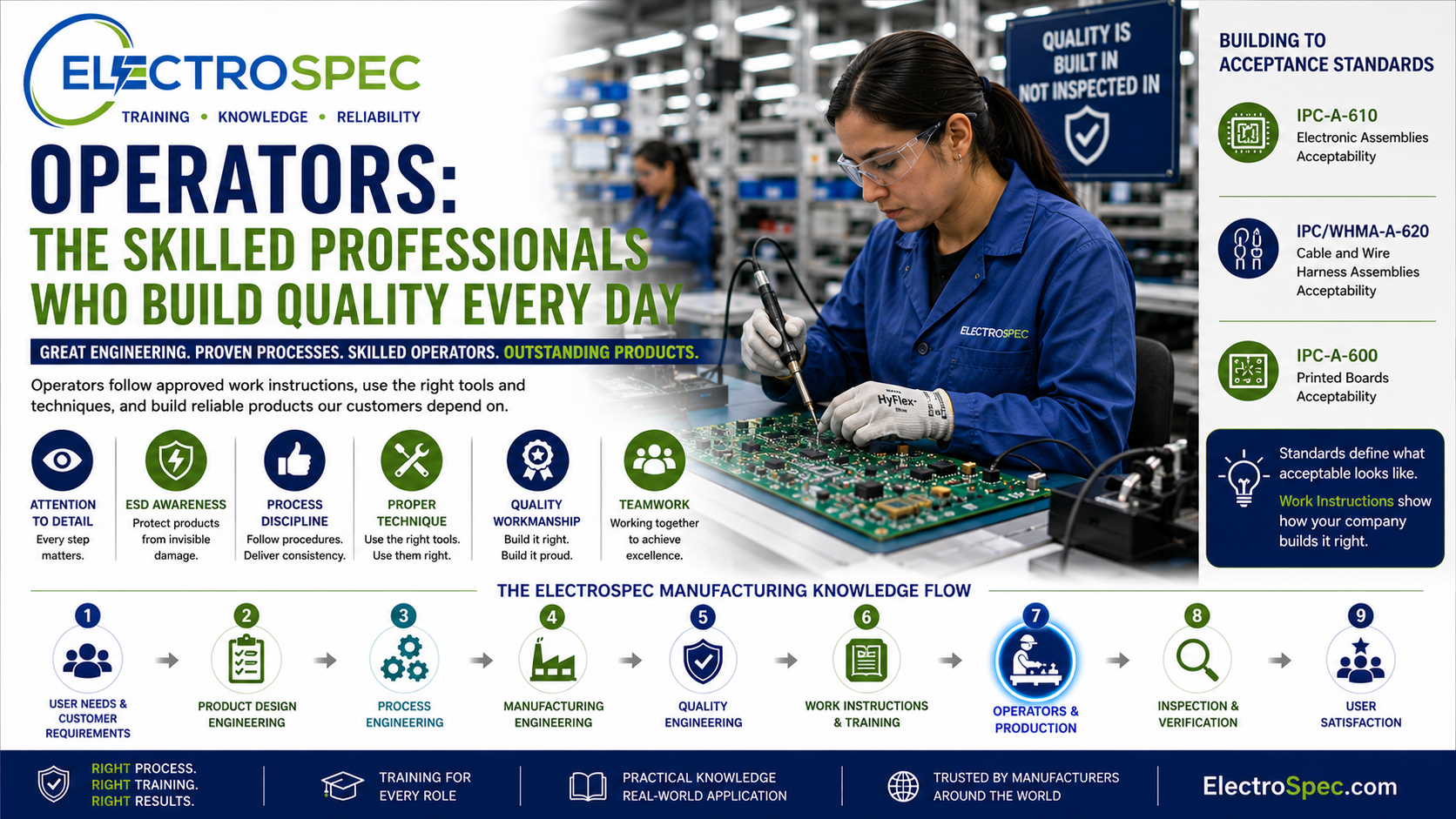
Operators transform engineering into products that improve lives.
Recommended ElectroSpec Learning Path
Operator training should match the products being manufactured.
Electronic Assembly Operators
- IPC-A-610
Cable & Wire Harness Operators
- IPC/WHMA-A-620
Printed Circuit Board Manufacturing
- IPC-A-600
Additional Knowledge
- Company Work Instructions
- ESD Awareness
- Product-Specific Training
- Equipment Qualification
- Safety Requirements
The best operators combine technical knowledge with consistent execution and pride in workmanship.
Final Thought
Operators should never be expected to compensate for weak designs, inadequate processes, poor work instructions, or ineffective manufacturing systems. When engineering, planning, and training are done correctly, operators are empowered to do what they do best—consistently build reliable products with skill, professionalism, and pride.
Quality is the result of an integrated manufacturing system, not the responsibility of a single individual.
Coming Next
Inspection & Verification: Confirming That Quality Has Been Achieved
We'll explore the role of inspectors, why product acceptance matters, and how inspection verifies the effectiveness of the entire manufacturing system—not just the work of the operator.
Soldering for High Reliability
IPC-A-600 CIS Certification — ElectroSpec
IPC-A-610 Certification & Training Course | ElectroSpec Training
IPC/WHMA-A-620 Certification & Training Course | ElectroSpec Training
iNARTE ESD Engineer Certification — ElectroSpec
iNARTE ESD Technician Certification — ElectroSpec