
Where Does Electronics Manufacturing Really Begin? It Starts with the User.
Jul 08, 2026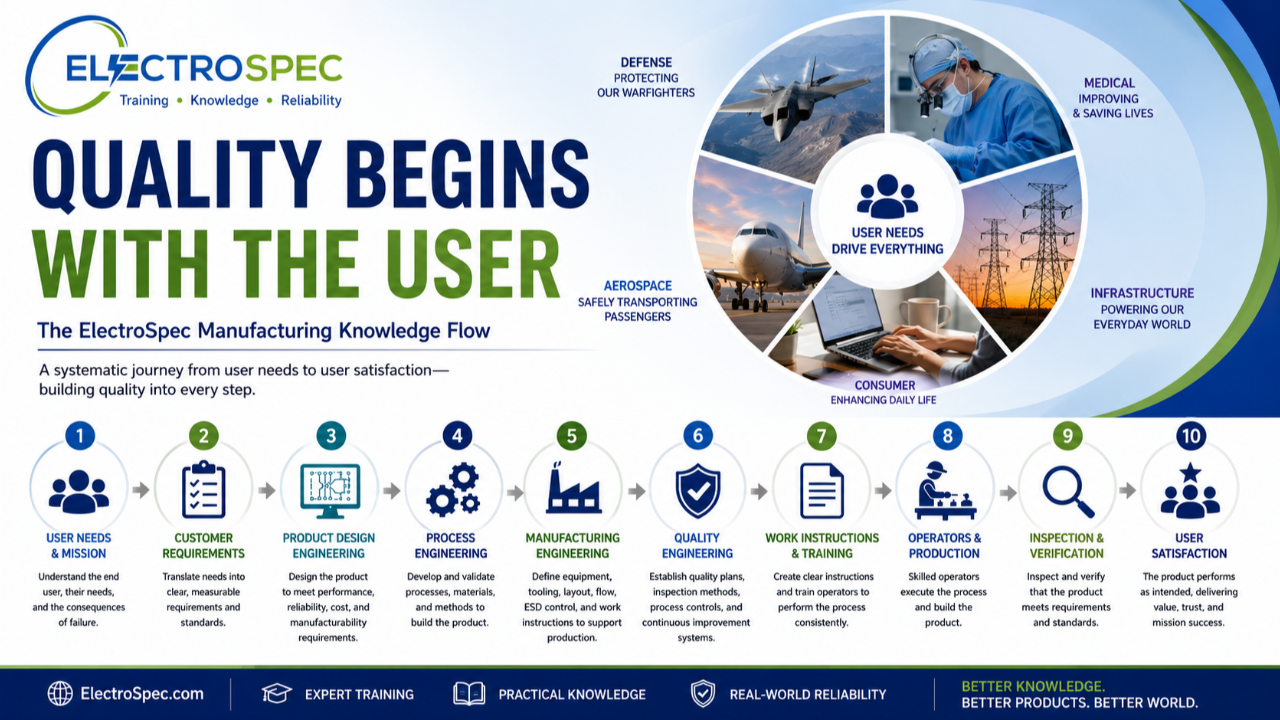
Ask someone where electronics manufacturing begins, and you'll hear a variety of answers.
Some will say it begins with product design.
Others will point to manufacturing.
Many quality professionals may answer that it begins with inspection.
While each of these activities is essential, they all begin one step too late.
Electronics manufacturing doesn't begin with a printed circuit board, a solder joint, or even a design drawing.
It begins with understanding who will ultimately use the product and why they need it.
That user defines everything that follows.
The Electronics Manufacturing Knowledge Flow
Every reliable electronic product follows a logical sequence from concept to completion. Unfortunately, many organizations focus only on manufacturing or inspection while overlooking the earlier decisions that ultimately determine product quality and reliability.
The ElectroSpec Manufacturing Knowledge Flow illustrates how quality is built throughout the product lifecycle. Each step depends on the quality of the work completed before it. When one stage is weak, every downstream activity becomes more difficult. Conversely, when each stage is executed well, the result is a robust manufacturing process that consistently delivers reliable products to the end user.
The journey begins with understanding the user's needs and ends when those needs are successfully met.
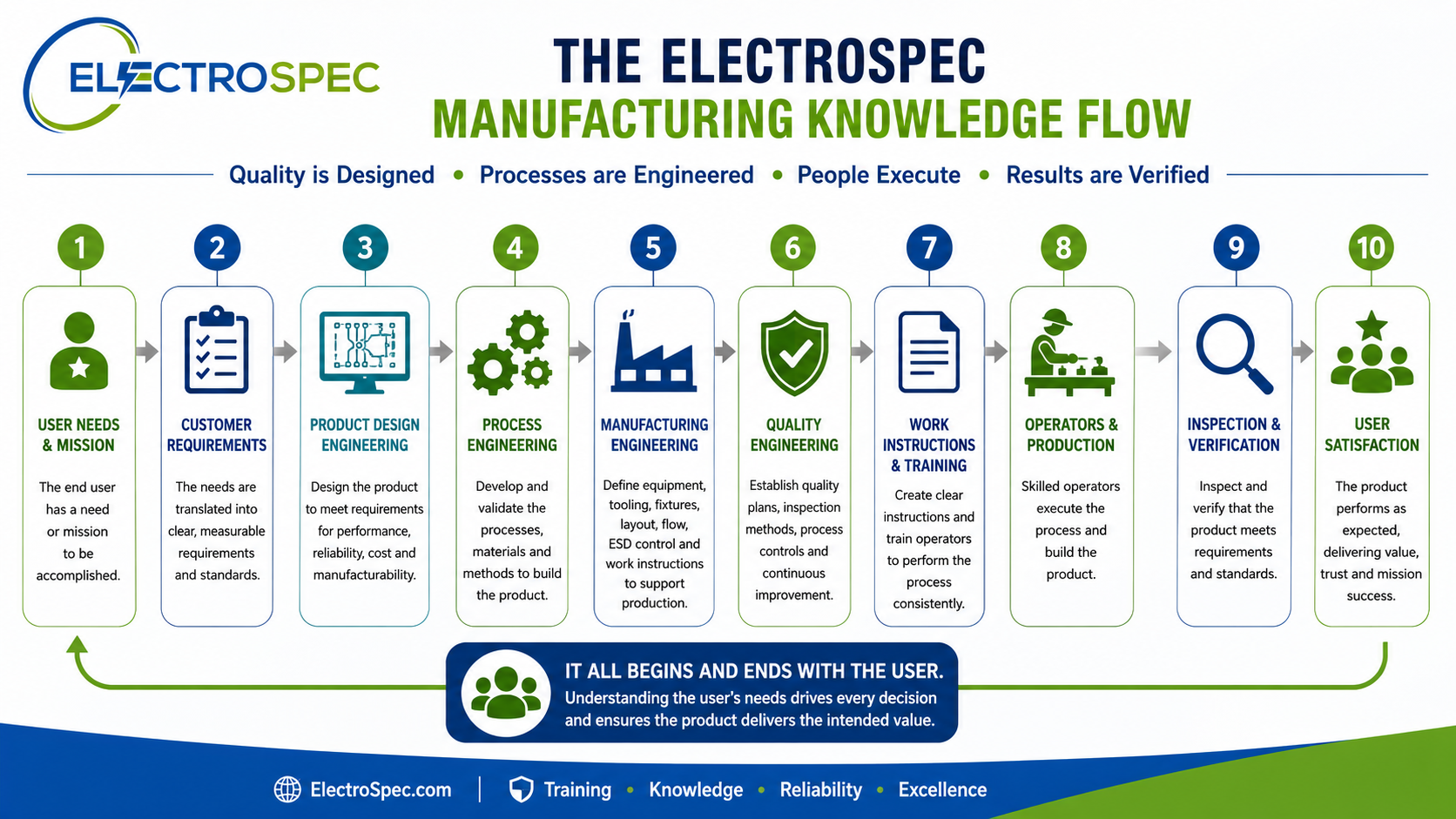
Then immediately after the graphic, explain each box briefly.
Understanding the Knowledge Flow
The diagram is more than a process map—it's a roadmap for building quality into every electronic product.
- User Needs & Mission – Every product begins with a person or organization that depends on it to perform a specific function or mission.
- Customer Requirements – User needs are translated into measurable technical, reliability, regulatory, and contractual requirements.
- Product Design Engineering – Engineers design a product capable of meeting those requirements while balancing performance, manufacturability, cost, and reliability.
- Process Engineering – Manufacturing processes are developed and validated to consistently build the product.
- Manufacturing Engineering – Equipment, tooling, materials, ESD controls, and work instructions are established to support production.
- Quality Engineering – Inspection methods, process controls, and quality plans ensure manufacturing remains capable and repeatable.
- Work Instructions & Training – Clear instructions and effective training prepare operators to execute approved manufacturing processes.
- Operators & Production – Operators build the product by following validated processes and documented procedures.
- Inspection & Verification – Inspectors verify that the finished product meets customer requirements and applicable acceptance standards.
- User Satisfaction – The manufacturing system succeeds only when the final product performs as intended for the user.
When one step is overlooked, every step downstream becomes more difficult.
Everything begins and ends with the user. Every engineering decision, manufacturing process, inspection criterion, and training program exists for one reason: to ensure the product successfully fulfills its intended purpose.
It All Starts with the User
Every electronic product exists because someone depends on it.
Sometimes that user is obvious.
A consumer purchases a laptop expecting years of reliable performance.
Other times, the user is part of a much larger mission.
A pilot depends on avionics to safely transport passengers.
A surgeon relies on medical electronics during life-saving procedures.
A warfighter depends on mission-critical electronics to accomplish the mission and return home safely.
An electric utility relies on control electronics to keep power flowing to homes, hospitals, and businesses.
Although these products serve very different markets, they all begin with the same question:
Who is the user, and what happens if this product fails?
The answer determines everything that follows.
User Needs Become Customer Requirements
Once the user's needs are understood, they are translated into engineering and contractual requirements.
These requirements define:
- Reliability expectations
- Environmental conditions
- Performance requirements
- Safety objectives
- Regulatory compliance
- Applicable industry standards
- Manufacturing quality expectations
Without clearly understanding these requirements, engineering decisions become assumptions rather than deliberate design choices.
Engineering Transforms Requirements into Reality
Product engineers convert customer requirements into designs that can be manufactured.
Process engineers determine how those products will be built consistently.
Manufacturing engineers select equipment, tooling, materials, and production methods.
Quality engineers develop inspection strategies and process controls.
Operators execute approved work instructions.
Inspectors verify that the finished product meets established acceptance criteria.
Each role depends on the quality of the work performed before it.
Quality Is Not Created at Final Inspection
One of the biggest misconceptions in manufacturing is that inspection creates quality.
Inspection does not improve a product.
It verifies whether the manufacturing system successfully produced an acceptable product.
True quality begins much earlier—with understanding the user, defining clear requirements, and building robust engineering and manufacturing processes.
When those early steps are done well, production becomes more consistent, inspection becomes more efficient, and reliability improves.
The Beginning of a Journey
This article is the first in ElectroSpec's Electronics Manufacturing Knowledge Flow series.
In the coming articles, we'll follow this journey through each stage of the manufacturing process, explaining how engineering decisions influence manufacturability, process development, inspection, reliability, and ultimately customer satisfaction.
Our goal is simple:
To help manufacturers understand not only what standards require, but why they exist and how every role contributes to building reliable electronic products.
Coming Next
Why Product Design Engineers Are the First Link in Manufacturing Excellence
We'll explore how design decisions influence every manufacturing step that follows and why PCB designers benefit from understanding manufacturability long before a product reaches the production floor.
If your responsibilities include PCB layout, hardware design, or product development, ElectroSpec's IPC CID and CID+ training programs provide a comprehensive understanding of the engineering principles behind manufacturable, reliable printed circuit board designs. Those courses will be the natural starting point as we continue this series.
Quality is not inspected into a product, it is systematically built into every stage of the manufacturing knowledge flow, beginning with the user's needs and ending with user satisfaction.
IPC-A-600 CIS Certification — ElectroSpec
IPC-A-610 Certification & Training Course | ElectroSpec Training
IPC/WHMA-A-620 Certification & Training Course | ElectroSpec Training