
Why Process Engineers Should Be Trained Before Operators
Jul 10, 2026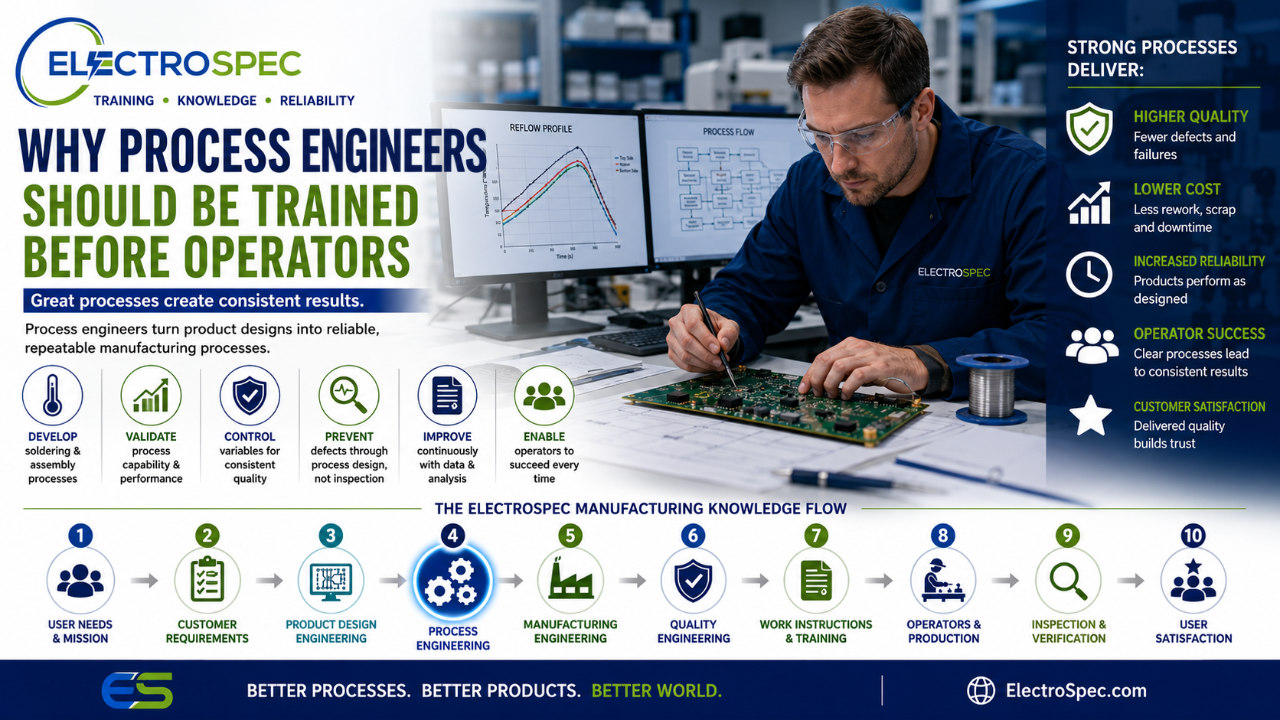
In the first article of this series, we explained that electronics manufacturing begins with the user and the mission the product must accomplish.
Our second article demonstrated that product design engineers establish the technical foundation by converting customer requirements into a manufacturable design.
The next step is equally important.
Someone must determine how that product will actually be built.
That responsibility belongs to the process engineer.
Great Products Still Need Great Processes
Even the best product design cannot guarantee manufacturing success.
A product may be electrically perfect, yet impossible to manufacture consistently if the production process has not been properly developed.
This is where process engineering becomes the bridge between design and manufacturing.
Process engineers transform engineering drawings into repeatable manufacturing processes capable of producing reliable products day after day.
What Does a Process Engineer Actually Do?
A process engineer develops and controls the methods used to manufacture electronic assemblies.
Typical responsibilities include:
- Developing soldering processes
- Selecting solder alloys and fluxes
- Establishing reflow and wave solder profiles
- Developing hand soldering procedures
- Moisture-sensitive device control
- Cleaning and cleanliness verification
- Conformal coating processes
- Rework and repair procedures
- Process validation
- Equipment qualification
- Statistical process control
- Continuous process improvement
These activities determine whether manufacturing consistently produces acceptable products.
Operators Execute the Process
One misconception in electronics manufacturing is that operators create product quality.
In reality, operators execute the manufacturing process that has already been developed, validated, and documented.
Good operators deserve excellent work instructions.
They deserve validated processes.
They deserve capable equipment.
They deserve stable materials.
When those elements are in place, operators can consistently build reliable products.
Without them, even highly skilled operators struggle to achieve consistent results.
Why Training Engineers First Makes Sense
Many organizations invest heavily in operator certification while providing comparatively little formal training for the engineers responsible for developing manufacturing processes.
That approach places tremendous responsibility on operators to compensate for process weaknesses they did not create.
Instead, organizations should first ensure that process engineers understand:
- Why solder joints fail
- Process capability
- Thermal management
- Metallurgical principles
- Flux chemistry
- Cleaning effectiveness
- Process validation
- Defect prevention
- Root cause analysis
When engineers understand these principles, they develop better manufacturing processes.
Better processes produce better products.
Prevention Is Better Than Inspection
The goal of process engineering is not to detect defects.
It is to prevent them from occurring.
Every defect prevented eliminates unnecessary rework, delays, scrap, and customer risk.
The most successful manufacturers focus their resources on process control rather than relying solely on inspection to identify problems after they occur.
The ElectroSpec Manufacturing Knowledge Flow
This article represents the fourth step in the Manufacturing Knowledge Flow.
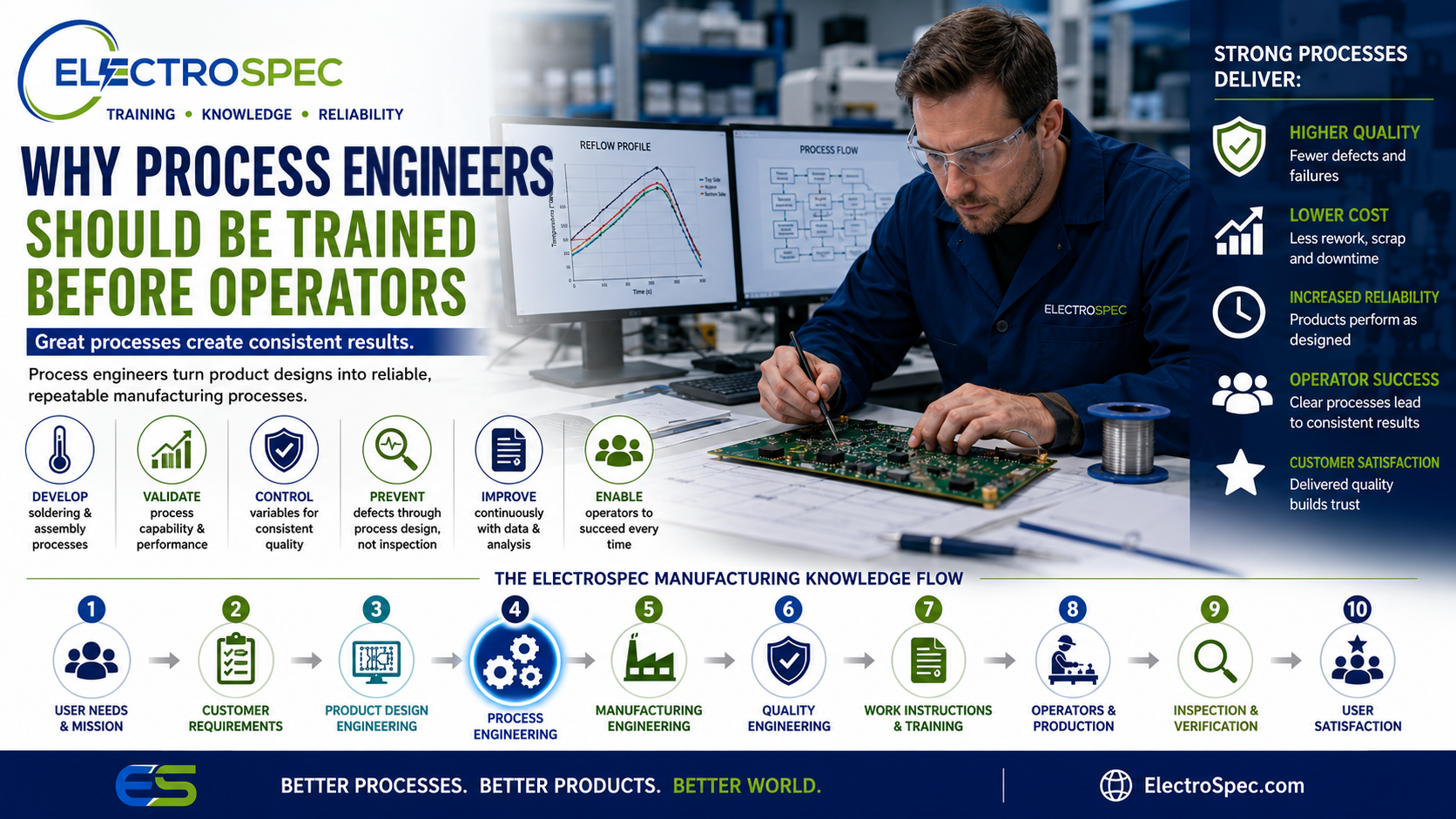
Today's focus is highlighted because it influences every manufacturing activity that follows.
Recommended ElectroSpec Learning Path
Process engineers benefit from understanding far more than product acceptance criteria.
They need a solid understanding of how reliable solder joints and manufacturing processes are developed, validated, and continuously improved.
ElectroSpec's High-Reliability Soldering & Rework program emphasizes the science behind soldering, process development, metallurgy, defect prevention, and manufacturing best practices. These concepts help process engineers build robust manufacturing systems that support consistent production.
While operators follow approved work instructions, process engineers create the manufacturing environment that makes success possible.
Coming Next
Manufacturing Engineering: Turning Engineering into Repeatable Production
We'll explore how manufacturing engineers bring together equipment, tooling, ESD control, work instructions, automation, and production planning to transform engineering concepts into efficient, repeatable manufacturing operations.
Soldering for High Reliability