
Why Product Design Engineers Are the First Link in Manufacturing Excellence
Jul 09, 2026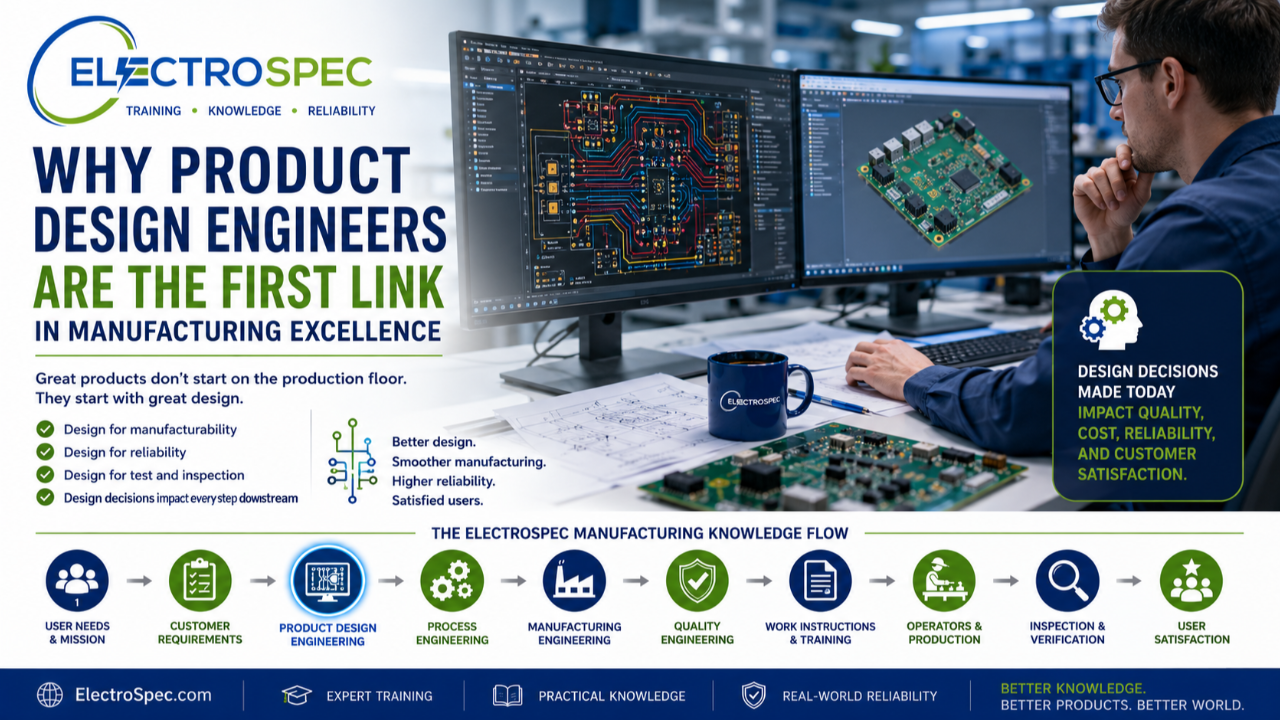
In our first article, Where Does Electronics Manufacturing Really Begin?, we introduced the ElectroSpec Manufacturing Knowledge Flow and demonstrated that quality begins with the user, not with manufacturing or inspection.
Once the user's needs have been translated into customer requirements, the next critical step is product design.
Every engineering decision made during product development influences every department that follows.
By the time a product reaches the production floor, many of the most important decisions have already been made.
The Design Engineer Sets the Direction
Product design engineers make decisions that affect the entire manufacturing process.
Those decisions include:
- Component selection
- Printed circuit board layout
- Material selection
- Thermal management
- Signal integrity
- EMI and EMC considerations
- Testability
- Manufacturability
- Reliability
- Cost
A well-designed product is easier to manufacture, inspect, troubleshoot, repair, and support throughout its lifecycle.
A poorly designed product creates unnecessary challenges for everyone else.
Manufacturing Cannot Fix Poor Design
Manufacturing engineers often receive products that are already difficult to build.
Process engineers develop creative solutions.
Operators perform exceptional work.
Inspectors verify compliance.
Yet none of these teams can completely overcome fundamental design shortcomings.
If components are placed too closely together...
If thermal reliefs are poorly designed...
If clearances are inadequate...
If test access is limited...
Those challenges become everyone's problem.
Good manufacturing begins with good engineering.
Design Decisions Influence Every Downstream Function
Every role benefits from thoughtful product design.
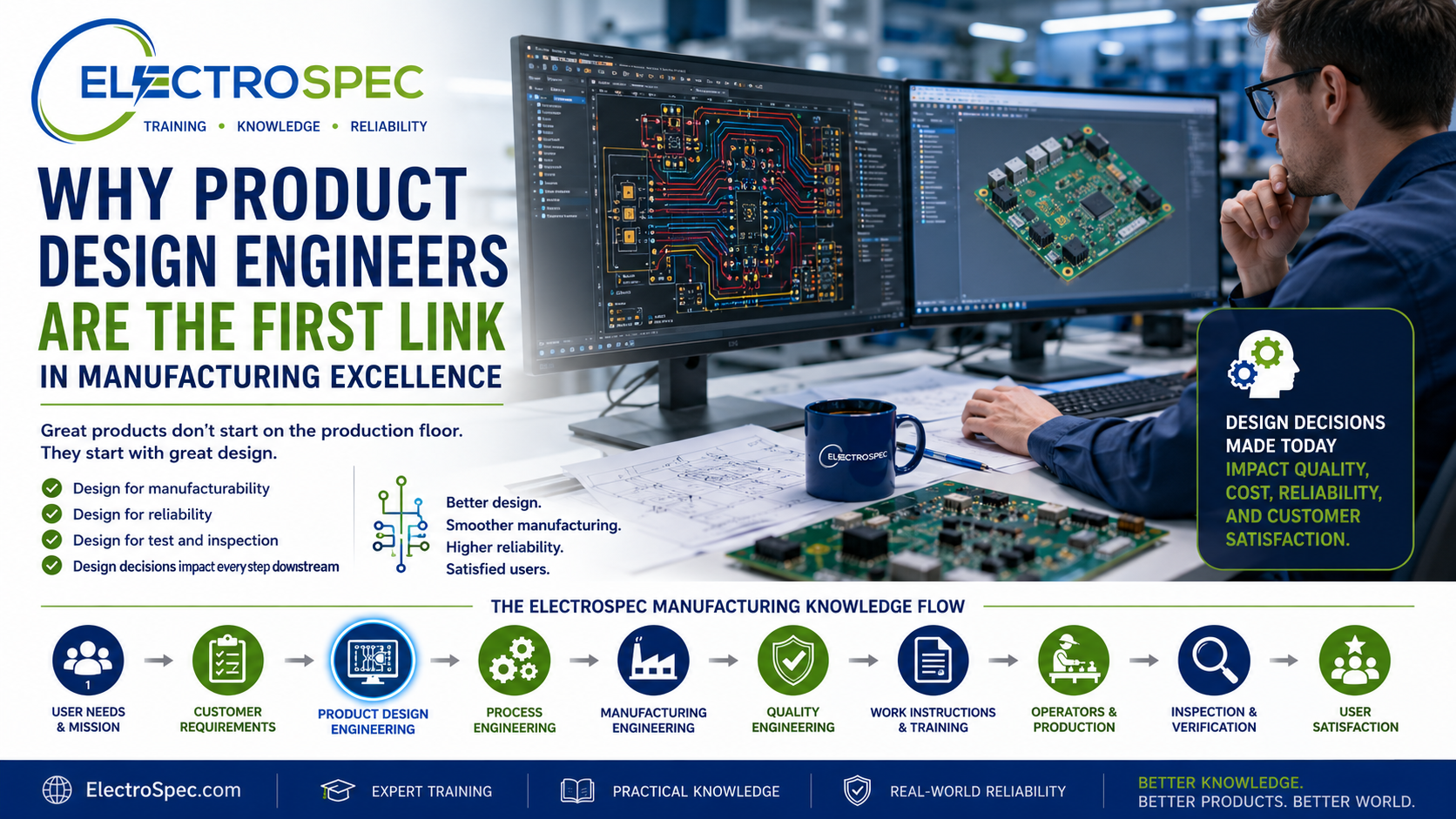
Process Engineers develop manufacturing processes based on the design.
Manufacturing Engineers select equipment, tooling, fixtures, and production methods.
Quality Engineers establish inspection methods and process controls.
Operators assemble the product according to approved work instructions.
Inspectors verify the finished assembly against established acceptance criteria.
The design engineer may never operate a soldering iron on the production floor, yet every solder joint is influenced by the design decisions made months earlier.
Designing for Manufacturing Success
Modern electronics require more than electrical functionality.
Design engineers must also consider:
- Design for Manufacturability (DFM)
- Design for Assembly (DFA)
- Design for Inspection (DFI)
- Design for Test (DFT)
- Design for Reliability (DFR)
Considering these principles early reduces manufacturing defects, improves yields, lowers production costs, and increases long-term product reliability.
Why IPC CID and CID+ Matter
Many PCB designers learn layout software exceptionally well.
Far fewer receive formal training on why design decisions influence manufacturing, inspection, and long-term reliability.
IPC CID and CID+ certification bridge that gap.
These programs help engineers understand not only how to design printed circuit boards, but how those designs interact with fabrication, assembly, inspection, testing, and field performance.
That broader perspective helps engineers make better decisions before the first prototype is ever built.
Building Better Products Starts with Better Engineers
Manufacturing excellence begins long before production.
It begins when engineers understand how their decisions influence every downstream activity.
The best manufacturing organizations don't wait until problems reach the production floor.
They prevent those problems during product development.
When engineers understand manufacturing, everyone benefits.
Production becomes smoother.
Inspection becomes easier.
Reliability improves.
Most importantly, the final product better serves the user whose needs started the entire process.
Recommended ElectroSpec Learning Path
Product & PCB Design Engineers
- IPC CID
- IPC CID+
- IPC-2221
- IPC-2222
Product Development Teams
- IPC CID
- IPC CID+
- Design reviews focused on manufacturability and reliability
The ElectroSpec Approach
ElectroSpec's IPC CID and CID+ programs emphasize not only PCB design principles, but also how design decisions affect fabrication, assembly, inspection, testing, and long-term reliability. Our goal is to help engineers understand the entire manufacturing system—not just pass a certification exam.
Coming Next
Why Process Engineers Should Be Trained Before Operators
We'll examine how process engineers transform great product designs into repeatable manufacturing processes and why they often have the greatest influence on manufacturing quality before the first assembly is ever built.
IPC CID Certification — ElectroSpec
IPC CID+ Certification — ElectroSpec