
Training, Certification, Qualification & Proficiency Are Not the Same Thing
Jul 18, 2026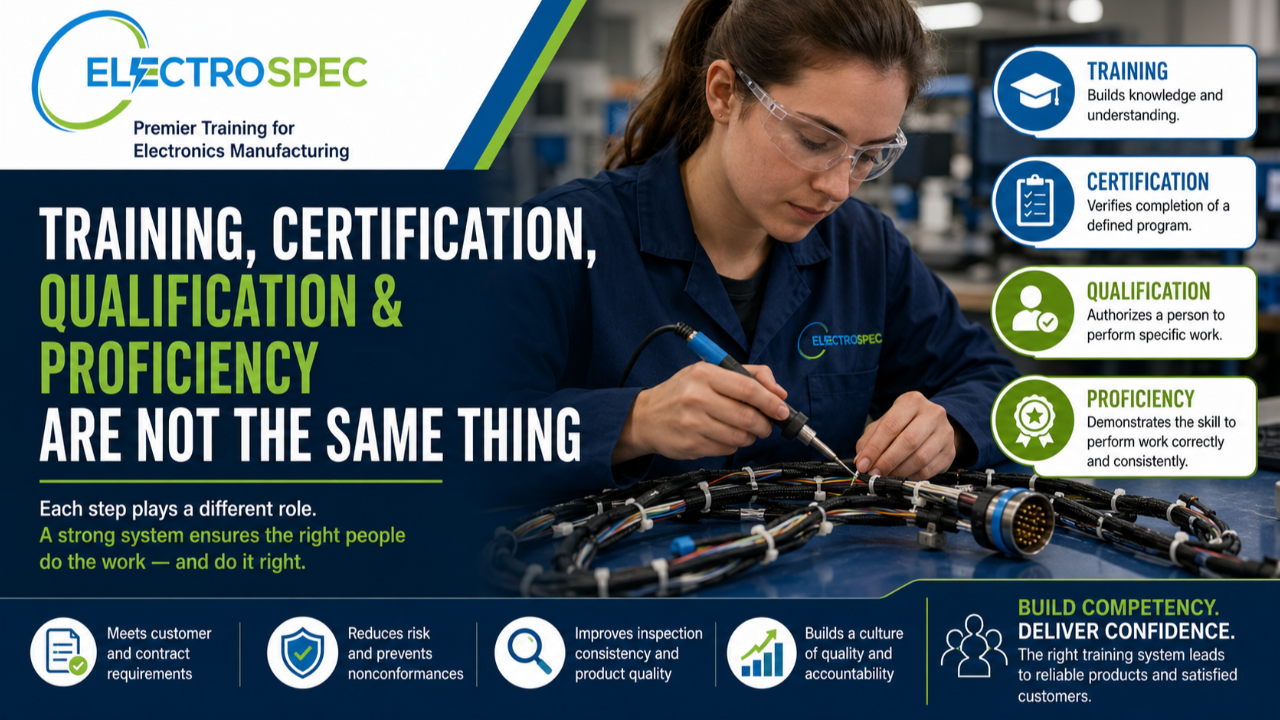
In the previous article, we discussed why IPC certification does not prove product conformance.
Certification may support knowledge of a standard, but product conformance requires objective evidence tied to the actual product, process, drawing, and acceptance requirements.
Now we need to go one step deeper.
In electronics manufacturing, four words are often used as if they mean the same thing:
Training.
Certification.
Qualification.
Proficiency.
They are related, but they are not the same.
Confusing these terms can create problems during audits, customer flow-down reviews, drawing interpretation, operator assignment, inspection planning, and high-reliability manufacturing.
Training Builds Knowledge
Training is the process of learning information, requirements, concepts, methods, or procedures.
Training may cover:
- Industry standards
- Company work instructions
- Product requirements
- Tooling
- Equipment operation
- ESD controls
- Safety
- Acceptance criteria
- Process controls
- Documentation requirements
Training helps people understand what they are expected to know.
However, training alone does not automatically prove someone can perform a specific manufacturing task correctly and consistently.
A person may complete training and still need supervision, practice, evaluation, or task-specific authorization before being released to perform production work.
Certification Verifies a Defined Program Was Completed
Certification means a person completed a defined certification program and met the requirements of that program.
In many IPC certification programs, students demonstrate that they can understand requirements, answer questions, locate information in the applicable standard, and apply criteria to defined conditions.
That is valuable.
It helps students learn the structure of the standard, recognize terminology, and apply acceptance requirements.
But certification is not the same as being qualified to perform every task associated with that standard.
A person can hold an IPC/WHMA-A-620 certification and still require additional training before building a specific high-reliability cable harness.
A person can hold IPC-A-610 certification and still require company-specific training before inspecting a particular product line.
A person can pass a standards exam and still not be proficient with the company’s tools, materials, drawings, and manufacturing processes.
Qualification Authorizes Specific Work
Qualification is different.
Qualification is usually the company’s determination that a person is authorized to perform a specific job, task, process, or inspection activity.
Qualification may be based on:
- Training completion
- Certification
- Supervised practice
- Hands-on demonstration
- Product-specific instruction
- Tooling instruction
- Process instruction
- Workmanship evaluation
- Supervisor approval
- Quality approval
- Periodic reassessment
Qualification should be connected to the actual work being performed.
For example, an operator may be qualified to crimp one connector family but not another.
An inspector may be qualified to inspect electronic assemblies but not cable harnesses.
A technician may be qualified for standard production work but not rework, repair, coaxial cable, RF connectors, or Space Addendum workmanship.
Qualification answers a practical question:
Is this person authorized by the company to perform this specific work?
Proficiency Demonstrates Skill
Proficiency is the demonstrated ability to perform a task correctly and consistently.
This is where manufacturing reality matters.
A person may understand a requirement, pass an exam, and even complete training, but still need practice before demonstrating true workmanship proficiency.
Proficiency may require the ability to consistently perform:
- Soldering
- Crimping
- Wire stripping
- Shield termination
- Splicing
- Connector assembly
- Harness routing
- Lacing and tying
- Coaxial cable preparation
- RF connector installation
- Rework and repair
- Inspection under magnification
- Documentation review
Proficiency is not theoretical.
It is demonstrated through actual performance.
That is especially important in high-reliability cable, harness, soldering, rework, aerospace, defense, medical, and space-related applications.
Why This Distinction Matters
If a customer or auditor asks whether personnel are trained, certified, qualified, or proficient, the answer should not be treated as one single thing.
Each term addresses a different level of evidence.
Training shows that a person received instruction.
Certification shows that a person completed a defined certification program.
Qualification shows that a company authorized a person to perform specific work.
Proficiency shows that the person can perform that work correctly and consistently.
All four may be useful.
None should be confused with the others.
The Space Addendum Example
The IPC/WHMA-A-620 Space Addendum is a useful example because it highlights the difference between knowledge and workmanship.
A person may be able to answer questions about Space Addendum requirements.
That does not automatically mean the person is ready to build a space-grade cable or harness assembly.
High-reliability cable and harness work may involve multiple wire types, connector types, terminations, shielding methods, coaxial cable, RF cable, routing, strain relief, and documentation requirements.
The real question is not only:
Can the person answer questions about the requirement?
The better question is:
Can the person consistently build or inspect acceptable product using the company’s actual tools, materials, drawings, and work instructions?
That is where qualification and proficiency matter.
Certification Is Part of the System, Not the Whole System
Certification can be an important part of a training and qualification system.
It helps establish baseline knowledge.
It supports common terminology.
It helps personnel understand requirements.
It may satisfy customer, contract, or internal procedure requirements where certification is explicitly required.
But certification should not be treated as the entire training system.
A strong electronics manufacturing training system includes:
- Standards awareness
- Company work instructions
- Product-specific training
- Process training
- Tooling training
- Hands-on practice
- Supervised performance
- Qualification records
- Proficiency demonstration
- Periodic reassessment
- Corrective action feedback
That is how companies build real manufacturing capability.
A Better Audit Question
Instead of asking only:
“Is the person IPC certified?”
A better audit question is:
“How does the company know this person is trained, qualified, and proficient to perform this specific task?”
That question leads to more meaningful evidence.
It may include certificates, but it also includes work instructions, training records, qualification records, supervisor approval, inspection results, and product-specific performance evidence.
Final Thought
Training, certification, qualification, and proficiency are related, but they are not interchangeable.
Training builds knowledge.
Certification verifies completion of a defined program.
Qualification authorizes a person to perform specific work.
Proficiency demonstrates the skill to perform that work correctly and consistently.
In high-reliability electronics manufacturing, companies should not rely on one word or one certificate to represent the entire personnel competency system.
The goal is not simply to prove that someone attended training.
The goal is to prove that the organization can consistently build and verify products that meet customer, drawing, and reliability requirements.
Need Help Building a Training Matrix?
If your organization is trying to separate training, certification, qualification, and proficiency requirements, ElectroSpec can help support the discussion.
ElectroSpec offers IPC/WHMA-A-620 base CIS certification and can help companies think through role-based training paths, internal qualification expectations, and evidence needed to support audits and customer flow-down requirements.
Coming Next
IPC Operator Training vs IPC Certification: What Is the Difference?
In the next article, we will compare operator training, standards awareness, and formal certification, and explain why generic training does not replace company-specific work instructions and task qualification.
IPC/WHMA-A-620 CIS Certification — ElectroSpec